Category Archives: Movies

Don’t Just Move…Stand There!

I’ve been pondering mobility, or rather the lack of it, as an important element in some horror films.

Normally, we’re a lot more a’feared of a terror whose current location is uncertain and moves mysteriously and quickly (ala the alien in Alien or corona viruses) than we are of a known and fixed enemy like…say…a patch of poison ivy. I don’t fear poison ivy, I avoid it like the scourge that it is. I can’t outrun much on this planet, but I can outrun poison ivy. It can’t “cut me off at the pass”. Viruses however…those little suckers are everywhere! This is the stuff of most horror flicks.

But there are a number of horror films that feature stationary menaces, or menaces that move at glacier-like rapidity. I have viewed a couple of these recently; The Living Head (Mexican), and The Head (German). Two other previously viewed films; They Saved Hitler’s Brain and Donovan’s Brain (both USA), would also fall into this sedentary and thus far inadequately studied category; films about living heads with no bodies (no legs, arms, wings, or driver’s licenses). The writers of these films are required to strive mightily to make these threats plausible since anyone could escape by simply falling down and crawling.

So, how do they do it?

Well, in The Living Head and They Saved Hitler’s Brain, we are shown mesmerized worshipers of the head toting it about from place to place. No one seems to notice or care or check the luggage until it’s too late.

In Donovan’s Brain the titular brain (aka the leading lobe) enforces its desires through emanations (wouldn’t that be a great name for a baseball team or a doo-wop group?)

In The Head it’s as if the writers don’t even try. The threat simply exists as a sideshow to be gasped at. Meh.

Until Brendan Fraser, mummy films had much the same problem. Bandage-bound Boris Karloff and Christopher Lee were not precipitous critters. Writers on these films worked hard to either trip or trap. They would trap their victims in a corner, or just trip them repeatedly, or paralyze them with fear. Fainting was a popular and useful (to the script writer) response. Plausibility fled as the mummy shuffled.

Two films come to mind that actually turned this lack of mobility into a positive. In The Invasion of the Body Snatchers, those malevolent pods can’t move, but are placed where they are most effective by previous victims of the pods. This is effective because of the mathematics of the situation. One victim begets two. Two beget four. Four beget eight. Eight beget… You see the problem. The rapid and devastating multiplication of zombified neighbors and public officials is completely plausible and scary, especially in today’s world of pyramid schemes. Of course one is left speculating whence cometh the terminus ad quo pod.

Personal note; I hate pods to this day. I look at sugar snap peas and shiver.

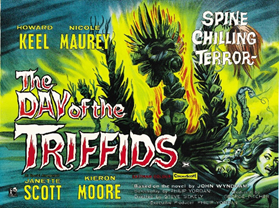
In the beginning of the film The Day of the Triffids, the starring plants apparently cannot move. But after the Earth’s population is blinded by a handy meteor shower, the plants pull up their roots and reveal their slow, but inexorable mobility. The fright factor soars. Kudos for the writer! BUT, look how hard it was to make effective – handy meteor shower? Please.

And that’s my point. Writing is hard work. Why make it harder? Writers should unleash their terrors, not nail their feet (or whatever might pass for feet) to the floor.

Indulge me one more example.

The Monolith Monsters featured mountains that grew quickly (stay with me, now) and fell on you if you were foolish enough to stick around and watch.

Let that sink in…but don’t let it fall on you.

This film reminded me of my one and only visit to Phoenix, Arizona. I looked out the window of my hotel room and saw, not too far away, a butte. Is that the correct term? There were two impressive houses built snugly into the base of the butte. I remarked to the bellman that I would be fearful of living in those houses because of the possibility of gigantic rocks falling on me. He replied that the rocks never fell.

Let that sink in.

I gazed again at the butte surrounded by the Greyhound-Bus-sized boulders that formed the 60-70 foot high slopes of the butte. It reminded me of my California-living friends who blithely dismiss earthquakes as a factor in their lives with; “But the weather’s so nice all the time.”

Blissful denial…perhaps that’s the key to the monolith monsters’ path to success.

Well, it might work for malevolent mountains but it’ll never get you elected president…or…

……give me a moment, I’m letting that sink in.

Japanese Noir

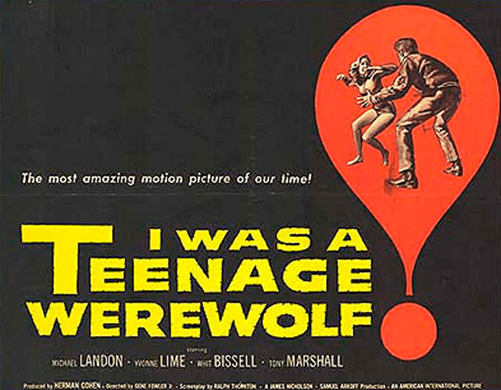
I watch some fairly awful movies with great regularity and glee. Nothing could promise less and truly deliver accurately on the promise than movies like The Giant Gila Monster or I Was a Teenage Werewolf. I maintain to this day that Gila Monster could have been nominated for an Oscar for best song in a movie. Hey, sure the song (chant?) is cheesy as hell, but it was a slow year for movie music. Gigi was better? I’m not so sure.

And Teenage Werewolf has points of interest.

  • Teenage boys are known to fret over their complexion and when they might start needing to shave. This flick posits a bizarre take on both anxieties.
  • Plus, watching Michael Landon struggle to bring life to this title character by grunting his lines (human and lycanthropic) makes the viewer ponder if this early acting challenge aided or impeded his mature dramatic efforts (Little Joe in Bonanza and the dad in Little House on the Prairie). It’s a head-scratcher for 30-40 seconds.
  • If this story were remade today, it would probably include a scene in which Nick Saban would pay a recruiting visit to our high-school werewolf promising to change Alabama’s football schedule to all night games.

What delights.

I also watch Japanese movies with regularity. They usually fall into one of two categories;

  • Happy foolishness featuring Godzilla or his runnin’ (actually flyin’) buddies Mothra, Rodan, Ghidra, et al.
  • Seriously serious films directed by Akira Kurasawa (the man is a god to me).

But tonight’s 1961 Japanese film is a new experience for me. None of the actors are wearing rubber suits, Tokyo is not destroyed, Toshiro Mifune is not in the cast, and thousands of mounted warriors with helpful identifying flags are not raising the dust.

Zero Focus (I haven’t a clue as to the meaning of the title) is beautifully directed by Yoshitaro Nomura. I prowl the overnight offerings of Turner Classic Movies just in hope of finding flicks like this.

If you are a fan of film noir and Hitchcock, this is your meat.

  • It’s in black and white.
  • There are trains.
  • The characters speak Japanese, but the language of the film is “bleak”. I happen to be fluent in bleak – I suppose it’s from doing too many Sam Shepard plays and walking out on too many productions of Waiting for Godot (patience is not my forté).
  • There are trains.
  • The plot twists and then twists again.
  • The characters play for keeps. Those who die stay dead, though occasionally we wonder.
  • Did I mention the trains?
  • Segments of Japanese post-war society of which I was totally ignorant are explored (dredged?).
  • I cared about every one of the characters in this story.

This is fine storytelling.

The acting is also fine. Excuse me for throwing some names at you, but these ladies are new to me and I was so very impressed.

  • Yoshiko Kuga is plain, pathetic, smart, and determined.
  • Hizuru Takachino is polished and desperate.
  • Ineko Arima is heartbreaking……………….just heartbreaking.

These women drive the film. How unusual is that for 1961?

Behind these performances, the music is gripping.

I was so taken by this film by Yoshitaro Nomura, I proceeded to watch reputedly his best film; The Castle of Sand. Lucky me.

The Castle of Sand contains another satisfying quota of “noir” elements.

  • It pairs an older/wiser investigator with a younger/more energetic partner (I’m hearing the theme music from The Streets of San Francisco now). They work on the case in question separately and come back together to compare their discoveries. Those discoveries are meager, but spark progress in each other through this cross-pollination. Yes, there are some “Eureka!” moments, but not the usual Hollywood kind. Mind you, I’m not knockin’ Hollywood “Eureka!” moments. They’re usually pretty exciting storytelling. But it’s intriguing to see these two hard-working, sweating, high-integrity guys tease just enough new information to keep their investigation flickering.
  • The film has bar scenes, dining car scenes, and police headquarters interview scenes. Check, check, and check.
  • Again, it has trains. I know that sounds strange but this is always good for me. It makes me a passenger with no control. I am caught in a powerful, loud machine hurling me towards the next chapter in the adventure at hand. Gulp.

The film does not have Ginzu knives.

But wait! There’s more!!

Unlike Zero Focus, this film is in color. Mr. Nomura uses that color to exploit the beauty of rural Japan. Imagine if the Ingmar Bergman of Smiles of a Summer Night had shot a film in rural Kentucky in early summer. The vistas are impossibly green and people stand small in them. The roads/trails are generally straight and so are the people. Integrity is high – tolerance is low. Hospitality is ubiquitous – charity is rare.

The acting in this film is perhaps not as uniformly fine as in Zero Focus, but the portrayal of the older detective by Tetsuro Tanba (fellow James Bond aficionados will remember Mr. Tanba as Tiger Tanaka in You Only Live Twice) is very nice.

The treasure in this film is the remarkable way the resolution is revealed and, as in Zero Focus, the intriguing use of music. Our detectives apply for a warrant to arrest their suspect. To do so, they must present their case to an assembly of police officials. As they tell their story we see their story in painful and lush flashback. As they speak and we watch, everything is underscored by a piano concerto written and played in concert by our prime suspect. The camera smoothly and logically and relentlessly moves from police conference to rural saga to concert performance. I could not look away. The plot twists as the story is unveiled are effective and startling………and plausible.

This is a gem.

A Prequel to CASABLANCA?

Are you a fan of the film Casablanca?

Do you have a pulse?

Are you worth knowing at all?

Depending on what day I’m asked, my reply to “What’s your favorite film?” is any one of about a half a dozen films, one of which is Casablanca. I could go on and on about the flick, but I’ll spare you the gush except on one point. Every time I see the ending of Casablanca, I wish there was more.

Duh-h.

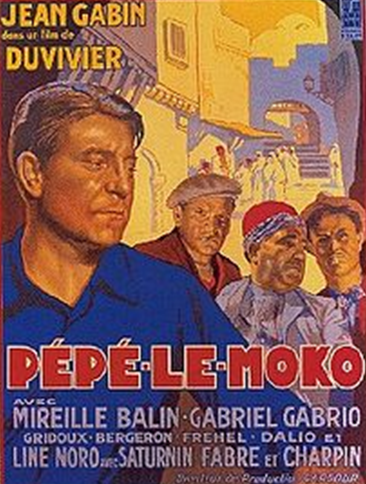
Well, it’s Movie Night and tonight’s entrée is the 1937 French offering; Pepe le Moko. This is well worth a look. There is much about this flick that is reminiscent of Casablanca, though Casablanca was actually made five years later.

Lucas Gridoux

Claude Rains played Captain Renaud in Casablanca as a man despicable in action but sympathetic in heart…and as smart as Rick (Humphrey Bogart). In Pepe le Moko, we have an outsider policeman named Slimane. He is played wonderfully by an actor I know nothing about; Lucas Gridoux. He also is despicable in action, but despicable as well in heart…and as smart as Pepe Le Moko (Jean Gabin). Gridoux slithers. He insinuates. He invades people’s space. He smokes their cigarettes…and needs a light. I felt the need for a shower after each of his scenes. It’s a fine performance.

Mireille Balin

Pepe, a thief and all-around rascal, is perfectly free to live as he pleases in the Casbah. The police are incapable of touching him there. He is also imprisoned in the Casbah. His power and immunity evaporate should he leave his safe haven. He pines for freedom. He pines for a Paris he remembers with a street-by-street affection. Sound like someone else you know? Maybe someone named Rick?

His memories of Paris are re-ignited by Gaby, played luminously by Mireille Balin. I watched their scenes with the phrase “We’ll always have Paris” running in my heart.

Marcel Dalio

The connection between these two films is further emphasized by the inclusion of Marcel Dalio in the casts. He plays an ill-fated messenger in Pepe, but is better remembered as the unfortunate croupier requesting additional funds in Rick’s Café Americaine in Casablanca. Mr. Dalio in real life was also married to the beautiful Madeleine Lebeau, who played Yvonne, Rick’s jilted local lover in Casablanca. Their real life desperate escape and winding journey from France to Portugal to Canada to the United States mirrors that of the refugees pictured in Casablanca. Marcel Dalio also appeared to good effect in La Grande Illusion, To Have and Have Not, The Rules of the Game, and Catch-22. Interestingly enough, he also played Captain Renaud in the TV series of Casablanca (1955-56).

Jean Gabin

Finally, there’s Jean Gabin.

I really like watching Mr. Gabin work. I have seen him referred to as a French Humphrey Bogart and I can see why though I see him more as a French Jean Gabin. His work in Port of Shadows and La Bete Humaine (both 1938) is compelling. Later in his career, in Four Bags Full (1956) he gives a performance full of surprise and relatively free of cliché. I’m a fan.

If you cherish Casablanca as I do, you will find much to delight you in Pepe le Moko.

Sign of the Wolf – 67 Year Old Spoiler Alert

Once upon a movie night!

Janie and I have been binge-watching GAME OF THRONES and our raggedy dog Chloe has been joining us. Chloe is quite taken with the wolves in the series and is now demanding to be referred to as our “dire” pup.

Whatever.

She’s good company though, so I’m trying to nurture her new-found cinematic interest. I allowed her to choose our film one night.

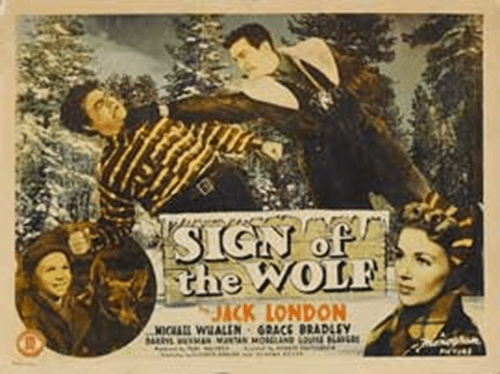
Unsurprisingly, she chose a 1941 Rin Tin Tin/Lassie wannabe; Sign of the Wolf.
The title is totally misleading. There are no wolves in the film – not one – zilch – nada.

There are however, not one but two big athletic Alsatian Shepherds named Smokey and Shadow. And if you think about it, that makes a kind of sense. You can’t reasonably expect any one dog to replace Rin Tin Tin or Lassie and to be perfectly honest about it, Smokey and Shadow combined are not really up to the mark either. Oh sure, they can climb walls and fences. They can jump hurdles. They can survive plane crashes. They’re faster than a speeding bullet. For real! They actually seem to outrun the dozens of rifle shots taken at them in this flick – it’s uncanny…and un-canine. The dogs do all these things in the film. To quote that great philosopher, Groucho Marx; “It’s a hell of an act!” But in the personality department, they are sadly lacking. It doesn’t help that they spend most of the film running around in dirty snow. How charming would you be? In my world, the only thing worse than snow is dirty snow. It’s a black and white flick – I can’t tell if the snow is yellow…but it’s dirty.

This is a Canadian production which is okay by me, but it means Smokey and Shadow bark in Canadian accents. It changes things in subtle, but disconcerting ways. Using the identical barks that Lassie employed to say; “Come quick! Timmy’s fallen in the well!” Shadow’s rescue-seeking bark is interpreted as; “Come quick! Mantan Moreland is trapped in a plane crash!” Frankly, I was baffled.

The film also features Dobie Gillis’ brother, Darrell Hickman as the “Timmy” character. I find most child actors to be quite moving and effective…and awful. Hickman simplified things by going straight to awful.

Dire Puppy

The film is based on the story by Jack London but that’s alright, Mr. London had died by the time this film was made so he didn’t get to see what happened to his story.


Then of course the snow fell for real at our house the next day and Chloe spent the next morning running around in the new, clean snow, barking in Canadian, and looking for plane crashes.

The neighbors fear she’s gone mad.

Camille Claudel and “Me Too”

A few days ago, I watched the film Camille Claudel again.

I think in these days of “ME TOO” and the obscene disparity in gauging the value of male and female work, this film has powerful things to say. Bullies and tyrants and narcissists do what they do “because they can” and “you can’t stop me”.

Resist them.

Shine the brightest of lights upon them and their actions.

Keep their path uneasy.

Point them out.

Stop them.

I’d also like to take a moment to reflect on the remarkable Isabel Adjani. Her performance in

this movie rips my heart out. The last shot of this ferociously talented character being carried away in a cage is devastating.

I am a big fan of Ms. Adjani.

Yes of course, she’s beautiful.

AND…

AND she’s given us other captivating performances in The History of Adele H., Nosferatu, Diabolique, and The Tenant.

Don’cha think it’s time we forgave her for Ishtar?

What THE POST is Not – Spoiler Alert

My friends continue their assault. They are determined I should watch some films from this millennium. But you’ll notice the films are set in the 1960’s. They’re trying to ease me into it.

Tonight it’s THE POST. It’s real good. I liked it!

BUT, it’s not ALL THE PRESIDENT’S MEN…and that’s OK.

It certainly looks like ALL THE PRESIDENT’S MEN…happily so. Ben Bradlee was there, in his same office, with his feet up on the same desk…happily so. The news room looked and sounded the same…yes, happily so. Nixon is foiled…so very happily so.

But the stakes are different in the events depicted.

In THE POST, the object of intrepid journalism is “The Ellsberg Papers”, a collection of reports about the history and motivations of a war in Southeast Asia assembled by a team in the Secretary of State’s office mostly by simply asking the Pentagon for the information. It was devastating information confirming the worst fears of a movement of young people opposed to a conflict that killed one to three-and-a-half million people (depending on whether you consider Cambodia, Laos, and political assassinations as part of the casualties – I tend to do so).

In THE POST, this devastating information was not that hard to obtain. The drama…the courage…the journalism was deciding to publish in the face of threats of court action by the White House.

The lesson to be learned was in the question of why it took so long to assemble the information that had been gathering since the early fifties. The answer was in the cozy relationship that had developed (festered?) between the press and the people in government. Hard questions, awkward questions got delayed and forgotten in the warmth of golf with Ike and touch football on the White House lawn with Jack and Bobby.

THE POST makes this point. My hippie sensitivities might wish the point had hammered longer and harder but that’s not fair. It’s a movie, a work of art, and a damn fine one, and the point was made within that reality.

The events depicted in ALL THE PRESIDENT’S MEN are about the clumsy burglary of the political office of an already defeated candidate. What’s the big deal?

– Only that the burglary was authorized in the office of the Attorney General of the United States.
– Only that the money paid to the burglars to buy their silence was raised by fundraisers of the President of the United States at his behest.
– Only that the President’s suggestion to the newly appointed head of the FBI was to drop his evidence in the Potomac.

I repeat; what’s the big deal?

I mean…no one died.

But two young nobody reporters sifted through files, pounded on doors, waited on recalcitrant elected witnesses, cornered reluctant participants, lingered in parking garages, and endured the public berating of the most powerful office on Earth to deliver a truthful report.

A report that a few years before might not have been published had not the Washington Post had the guts to publish “The Ellsberg Papers”.

ALL THE PRESIDENT’S MEN is the better film.

How could it not be?

I might be the world’s biggest Meryl Streep fan and I can’t be far behind on Tom Hanks. But ALL THE PRESIDENT’S MEN has complete performances by Dustin Hoffman, Robert Redford, Jack Warden, Jason Robards, Jane Alexander, Penny Fuller, Hal Holbrook, Ned Beatty, and Martin Balsam.

Wow!

I have confessed to being both an old hippie and a true geezer. I have lived through these events.

If you are interested in moving towards a relevant-to-today understanding of these happenings, may I offer a triptych?

– See THE POST, it’s real good.
– Read ALL THE PRESIDENT’S MEN (Woodward/Bernstein).
– See ALL THE PRESIDENT’S MEN it’s even better.
– Read THE FINAL DAYS (Woodward/Bernstein).
– Read BLIND AMBITION (John Dean).

I have a writer friend who talks about the mystic power of three.

It seems much of my art-consuming life, I have encountered trilogies regularly (…and happily so); THE LORD OF THE RINGS, STAR WARS, Kieslowski’s THREE COLOURS, Clint Eastwood’s DOLLARS westerns, THE GODFATHER, and INDIANA JONES.

Might this be another?

THE POST, ALL THE PRESIDENT’S MEN, ……?
The Shape of Water – Spoiler Alert

I have friends who try like hell to drag me into this millennium.

It’s tough and thankless duty.

I immerse myself happily in “Thin Man” movies, and Casablanca, and Mexican monster movies, and 70’s/80’s giallo gems from Europe, and just about anything Fellini touched. My playlist includes Crosby, Stills, Nash and Young (and Bing Crosby for that matter), Coltrane, Johnny Hartman, Joni Mitchell, Carmen McRae, and Luciano Pavarotti. I avidly devour books by Kerouac, Edgar Wallace, Tolkein, Didion, and Hurston.

But thankfully, my obstinate friends insist I read Carlos Ruiz Zafón and Neal Stephenson, listen to Anais Mitchell and Anat Cohen…

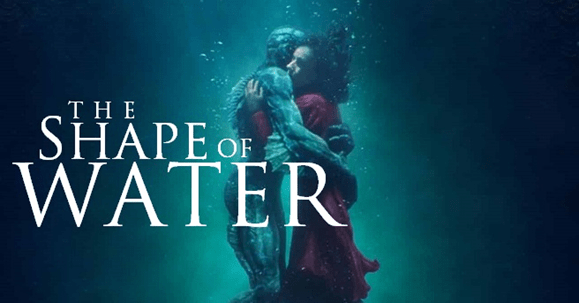
…and watch The Shape of Water.

I love this film.

It’s a love story with monsters…river monsters and 1960’s Cold War-driven human monsters.

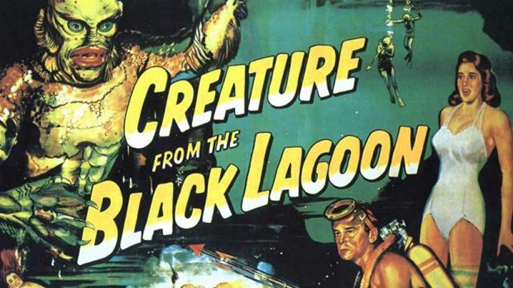
It’s the logical extension of The Creature of the Black Lagoon sans the inexplicable white swimsuit or any swimsuit at all for that matter.

It’s a love story that finally answers the question; “Which came first, the chicken or…?” SPOILER ALERT; it’s the egg.

It’s as dark in palette as Blade Runner and as wholesome as Fred and Ginger.

Thank you to Guillermo Del Toro for directing and writing this film.

Thank you to my friends for tugging me out of the 20th century.

A Last Wave Unleashed

Movie night!

I like Peter Weir movies and tonight I’m watching The Last Wave.

This flick gets ripped for being obscure and for not solving the mystery.

I will grant the latter. I think one of the responsibilities of artists who trade in mysteries in movies and books is they must, at some point, solve the mystery. Is that too much to ask? In both The Last Wave and Picnic at Hanging Rock. Mr. Weir chooses not to do so. I still like both films.

I will however, take issue with the accusation of obscurity.

Since my teens, I’ve had a literary addiction to novels and stories of the supernatural. One of my favorite British authors is from the early 20th century; Arthur Machen. Machen writes often of nature in revolt – of nature, thought to be tamed, but perpetually about to bust out and re-exert dominance over man in disorienting and disturbing ways. In this light, The Last Wave makes amazing sense.

Nature hovers. Disturbing and disorienting intrusions occur.

  • Baseball-sized hail falls from a cloudless sky.
  • From his protective bubble of a car in a torrential downpour, Richard Chamberlain sees;
    • A man with an extreme umbrella drinking from a water fountain. Why doesn’t just open his mouth? No, he chooses the “tame” water over nature’s wild water.
    • A poster for the local zoo featuring apes gazing back at Chamberlain in his car. Who’s really caged and on display?
    • Vehicles crawling through snarled traffic with icons on them featuring the image of a jungle cat; jaguars in the streets.
  • At Chamberlain’s home, with the maelstrom outside continuing to rage, turning the windows of the home into images like the inside of a dishwasher, water appears inside the house flowing down the stairs. We immediately assume there’s been a leak from the outside, but it turns out to be a bathtub overflowing. Water thought to be tamed…
  • Chamberlain’s wife admits that she’s a fourth-generation Australian, but she’s never met an aboriginal. She’s lived distanced from nature, behind societal barriers that now appear to be quite fragile.

This is not obscure. It’s mysterious and ominous, but not obscure. We think we’ve tamed and sealed out nature from our lives. (Climate change? Pshaw!)

But nature will persist. It will find a way past our barriers. It will win. How scary is that? Nothing obscure at all.

It’s a fine and effective film.

A Return to Sunset Boulevard

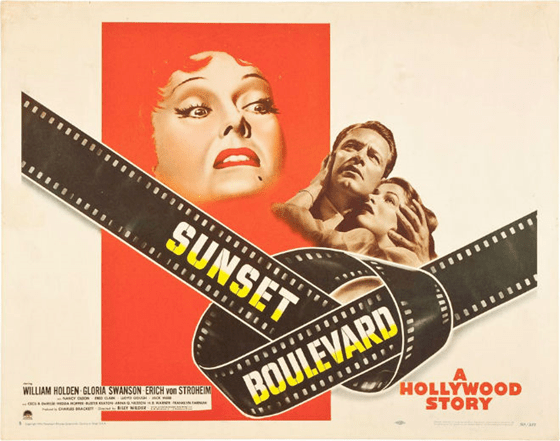
I revisited Sunset Boulevard.

Make that “An American Story”

Not the whole street – 10086 Sunset Boulevard, the home of Norma Desmond to be precise.

Before my viewing revisit, it had been almost 40 years since I’d been there and it has changed…or probably, I have.

I remember seeing it before with a sensitivity short on life experience and fresh from a recent viewing of Whatever Happened to Baby Jane, a callow and totally incorrect approach on my part. Hollywood madness played large and deadly.

I accepted the criticisms of many that Gloria Swanson’s “campy” performance to be accurate. (Cue the loud buzzer and the announcer’s voice; “Thank you for playing!”).

I believe the two most difficult things for an actor to play are;
1. Not pretty, and
2. Not smart.

Not so comfortable — not so safe

It’s not so hard to play ugly, and it’s not so hard to play stupid. It’s actually quite comfortable and safe. After all, audiences will surely know you’re merely acting and it’s not really you. Ditto with playing smart and pretty. But “not smart” and “not pretty”…that’s a little close to home. People MIGHT think you’re not having to act too much…maybe it’s what you are…not smart and not pretty. That’s not so comfortable and safe, eh?

I watched Sunset Boulevard with a group of movie lovers and one of them suggested that Ms. Swanson’s performance wasn’t campy at all. “This was how Norma Desmond and her colleagues acted in their silent roles, it only makes sense that this is how they act in life when they’re ‘on’.” That sounds right to me and Ms. Swanson’s performance seems perfectly plausible today. Now, keep in mind, I’m not averse to chewing my own share of scenery when the opportunity presents itself…or even when it doesn’t. Who am I to begrudge an actor their dose of over-the-top?

I think this is a brave performance by a 50-year-old actress in 1951 when there weren’t many roles for 50-year-old actresses. The character was exotic and glamorous…but not pretty. She was certainly not smart. And while she was not old, she was “not young”. Today, this performance could have unleashed subsequent movie offers galore. In 1951, Ms. Swanson was rewarded with few scripts and they, according to her, were merely re-channelings of Norma Desmond. Perhaps people were thinking she was not having to act too much? William Holden sprang from this film to box-office stardom. Ms. Swanson drifted into retirement…in her 50’s!

Rockin’ the threads

Speaking of William Holden, he is just fine in the flick, and he completely rocks the clothes…even the vicuna overcoat (“…since the lady’s buying…”).

But what about Joe Gillis, the character he’s playing?

I will admit to some relief when he was killed in the film. I was beginning to be teased by the outré possibility that Dobie Gillis might have been the bizarre offspring of Norma Desmond and Joe Gillis – not a good place to go.

Seriously, there is little to admire about Joe Gillis. The show opens with him in his bathrobe, in a maelstrom-designed apartment, three months behind on his rent and car payments, lying to his car re-possessors, and accepting the hospitality of a deluded older woman preparing for the funeral of her chimp.

There’s a job opening

Her chimp!
What’s that?
There’s opening for a chimp in this household? What is Joe Gillis thinking?

Joe has some of the best lines in the movie but they’re usually preceded by something amazing said by Norma. Thus, we miss his comments. For example;
Norma; “I am big! The movies got small!”
Joe (under his breath); “I knew something was wrong with them.”

It’s another of these mutterings that makes you completely write Joe off as an admirable human being. As Norma and Joe are out one evening in Norma’s remarkable car, Joe’s narration remarks; “By then, she had taught me to play bridge.” It’s a complete capitulation to comfort, clothes, chimp-dom, and the ultimately fatal swimming pool.

Buyer’s remorse

At least he has his moment of redemption. He finally jettisons the jewels, the clothes, the girl, the house, the car and the pool. BUT a Faustian bargain is made up front and there’s no going back. The terms are made early and the price of the transaction is not altered by buyer’s remorse. We have rooted for Joe in spite of his unworthiness of our sympathy, we resonate with his redemption, and we are saddened but unsurprised by his demise. Forget that $35-a-week editing job in Dayton – you bought the pool, mister.

Have I mentioned that I love this film?

Halloween Euro-Trash

It’s Halloween season and it’s movie night!

I’m immediately hooked solid when a flick’s philosophical underpinnings are spelled out in the opening dialogue and are obviously words to live by.

In tonight’s film, a casual chitchat suggests;

“Dealing with a murderer is not only repugnant, but it can lead to…complications.”

While I accept the probable veracity of the statement, I have yet to have this sentiment pop up in any conversation. That’s most likely for the best. I suspect a life too-filled with “murderer”, “repugnant”, and “complications” in its language is directly linked to a reduced life expectancy.

But in a horror flick? We’re off and running!

Now that line sounds like something Charlie Chan might have said. But no, it’s one of the many pearls of wisdom included in the Euro-trash classic; The Hunchback of the Morgue. This is another inexplicably overlooked candidate for adaptation to a Broadway musical.

Check out this snappy exchange;

“Sulphuric acid!”

“Yes. We’ll be using it to dispose of the anatomical parts and other organic things.”

Let’s ponder that for a moment, shall we? …”other organic things”… what could “other organic things” possibly be? And do we really want to know?

This film has many of the basic elements of great bad film-making;

  • A secret cave with shiny, jagged rock walls but a perfectly flat floor (only in the movies can such a geologic miracle exist).
  • A fully functional mad doctor laboratory (with much gurgling and bubbling equipment) in said secret cave.
  • Sporadic electricity (besides most of the acting). This state-of-the-art laboratory is lit by torches, but the electrical equipment works – go figure.
  • Whispering. Everyone in the film whispers. Everyone, everywhere, all the time. I’m guessin’ the actors are actually moonlighting golf commentators.
  • A hunchback with a foot fetish and the ability to climb tile-roofs like Cary Grant in To Catch a Thief.
  • A student nurse whose apartment has dead animals and a Modigliani hanging on her walls. Clearly student nurses make damn good money in Europe and have a remarkable range in taste.
  • Grave-robbing, decapitation, artificial life (besides most of the acting).

The only thing missing in this epic is Godzilla!

Great bad Halloween fare

I loved it.