Tag Archives: Christopher Lee

Let the Right One In

I love horror movies.

Good, bad, silly, gory, American, Spanish, Italian, British, Chinese, Argentinian, Japanese, French, Mexican, German, Brazilian…even Swedish.

Especially vampire flicks.

Why?

I think those seeds were planted early by scarcity.

Through my high school years, we only had the three local TV channels, and Dad essentially controlled the remote. The remote, at that time, was me.

“Roger, go over there and switch it to channel 27.”

After high school, I didn’t have a TV at all until I was 22. I intruded on my friends’ TV’s, or schlepped up to the communal screens on the top floors of the towers at UK. Thus, film viewing opportunities were sparse and sporadic. I didn’t see Bela Lugosi’s DRACULA until I was about 14 (a bleary late Saturday night, installed on the living room floor, armed with a pillow and a hope that the rooftop antenna was aimed in the correct direction). I think I saw my first Christopher Lee bloodsucker in my 20’s and I had that Groucho Marx epiphany; “How long has this been going on?”

Now, that sounds pitiful, but it’s not.

In those years, eight nights out of ten, I was rehearsing a play somewhere, and working to pay the rent during the day. Who had time for movies? Not me, no time…but a pent-up desire musta been a’building.

Since those brutally-deprived days, I’ve tried to make up for lost vampire flicks. Happily, I still haven’t exhausted the historic backlog, and that was proven again last night.

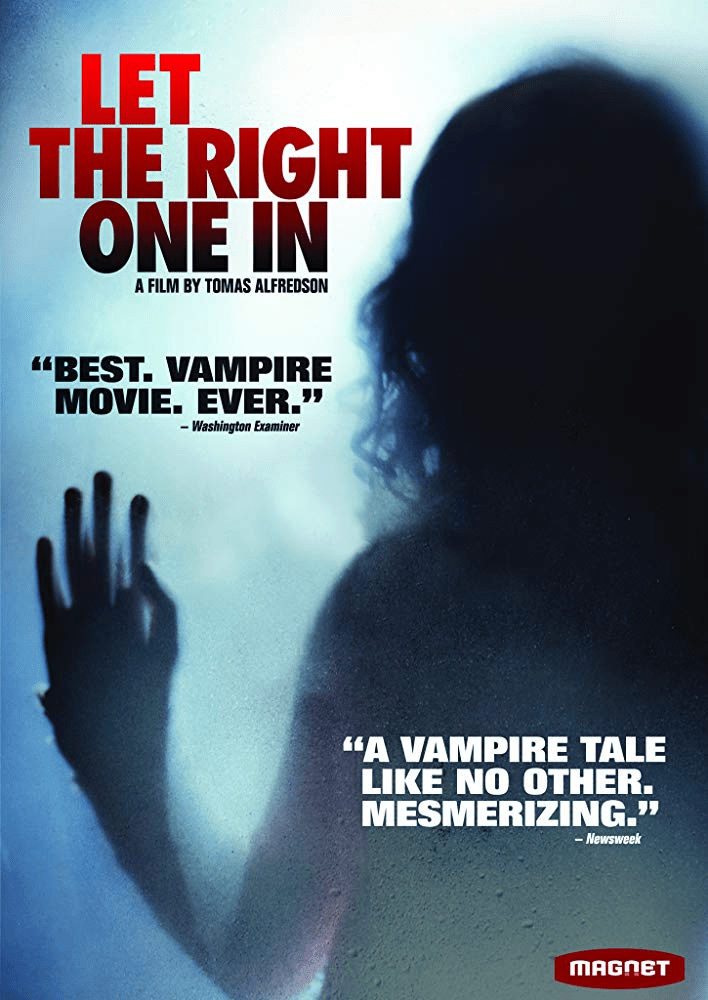
A friend called and invited himself over to watch a film he wanted me to see. It was Tomas Alfredson’s 2008 Swedish film; LET THE RIGHT ONE IN.

There was much to like here.

The vampire element of the film is innovative and empathetic. One cares about and frets over the challenges being faced by this 200-year-old/12-year-old child hazard. One cares about and frets over her bullied and neglected 12-year-old/12-year-old neighbor. One cares about and frets over the flawed, ineffective adults around the children’s lives. The only unsympathetic characters are the young school bullies who are simply making Scott Farcas-like decisions with similar results.

The ending is satisfying and troubling simultaneously. It made me long for a sequel just to answer a few questions I’d like to pose.

I really have only two complaints with the film.

  1. I watched a dubbed version. I thought the voices were disconnected and flat from the happenings on the screen. It reminded me vaguely of the dubbing in those awful/wonderful Mexican monster movies of the 60’s. I think I would have preferred subtitles.
  2. It’s full of all that Nordic gloom and snow and cold. This child of American South sun and humidity just can’t………. But that’s me.

This is a real nice flick.

I think you can let it in.

Purging Fire Cures All

Movie night!

HORROR CASTLE aka THE VIRGIN OF NUREMBURG (1963) is tonight’s cinematic delight. It features the ubiquitous Christopher Lee and the constantly-backlit-in-her-negligee Rossana Podesta (even when the only source of light is the candlestick she holds in front of herself – I’m not complaining, you understand – but it defies the laws of physics).

Chris Lee is menacing and ruthless and dubbed in English for some unfathomable reason.

Ms. Podesta is best known for her work in various sword and sandal epics, especially HELEN OF TROY in which she allegedly beat out Elizabeth Taylor for the titular role.

I’m expecting this epic will end in a purging European fire as most of these giallos do. These euro-trash classics seem to feature Prometheus as their go-to deux-et-bonfire in virtually every machina.

Sho ’nuff. It all goes up in flames and Mr. Lee bites the dust as usual. However, Ms. Podesta survives, perfectly coiffed, and ready for the next dim staircase.

I loved it.

Let’s Give a Big Hand to Orlac

Movie night!

We think of Hammer Films and we think of Dracula and Frankenstein and strawberry-red blood dripping on otherwise pristine sets in sunglass-required lighting that comes from everywhere and nowhere in particular. But even as these money-making machines were being crafted, Shepperton Studios was cranking a bunch of other films just as interesting…if not as lucrative.

This is one of them. THE HANDS OF ORLAC (1960), directed by Edmond T. Gréville, is another retelling of the transplanted hands saga and not the best of that gruesome genre. That dubious award would go to Peter Lorre’s MAD LOVE (1935) in my book.

But THE HANDS OF ORLAC is a pretty entertaining flick. It is encumbered by a somnambulant performance by Mel Ferrer, but it features a nice turn by Christopher Lee as a blackmailing stage magician. Lee’s character shrieks a ridiculous wild laugh (always wisely off-camera) that sounds like a cross between Snidely Whiplash and the happily surreal cackle preceding the Ventures’ “Wipe Out,” (which, I understand was inspired by one of the Maddox Brothers). Whew, that last sentence should give everyone fun things to google.

Lucile Saint-Simon

Even better than Mr. Lee’s performance are the ladies in the flick. I thought I had never heard of Lucile Saint-Simon before, but I see that she’s also in a blade-filled Italian giallo from 1963; THE VIRGIN OF NUREMBERG (more tamely released in the US as HORROR CASTLE), directed by sanguinary maestro Antonio Margheriti and also featuring a murderous Christopher Lee. I remember being moderately engaged by the flick a few years ago, but I’m gonna have to watch it again now. Ms. Saint-Simon is sympathetic and rocks her negligee, though the backlighting in this effort is insufficient to satisfy my more demanding geezer cineastes. Dany Carrel, however, more than makes up for that technical deficiency. Her night club act with Chris Lee is eye-popping…literally. The white-haired guys in the audience are dropping their monocles and checking their pacemakers.

And in addition to those actors, a small appearance by the ubiquitous Donald Pleasence provides a coup de gross (sic and deliberate) for the evening.

The ending ties things up in a way-too-convenient way. You might call it a deux-et-manicure copout.

But I liked it.

Avoiding Covid Nightmares

SCARSO03I have a friend who loves movies, but was forbidden horror flicks as a child by parental decree. As an adult, he has always been a busy, busy guy; works hard (and a lot) and plays just as hard (and yes, a lot).
At least he did.

Ol’ Mr. Covid has him workin’ from home these days and nights, hidin’ his face, and checkin’ the TV guide.

Now, his age having earned him his Most-At-Risk achievement badge, and having burned through most of Netflix, he was thinking of finally dipping his toe into the horror movie pool (provided he be assured of getting his toe back).

He knew of my fascination with awful films (content and competence) and asked if I might suggest a sampler of gruesome cinema.

Oh…I might…I very well might……and I did.

I suggested a double feature with a lagniappe.

I would start by queuing up Manos, Hand of Fate (1966) and setting a timer for two minutes. That’s all you need. It’s kinda like most of the songs in “Phantom of the Opera” – the same six words rolled around forever in various permutations. Don’t get me wrong, Manos is a truly, deeply, greatly, lousy film and well deserving of every ugly thing that’s been said about it. However, even loving it as I do, two minutes is plenty. It justifies all the parental decrees against horror films and validates the reverence you feel for your folks.

Then I suggested The House of Usher (1960). It’s a Roger Corman effort; safe, distant, costumed from another time, featuring moonlit seas and a castle, dark and looming. In short, a solid horror film vocabulary, but nothing too close to home to keep you up at night. However, the Richard Matheson script is scary. The performers? Well, Mark Damon is a total cypher, but Vincent Price’s hair is to die for, and someone very well may.

My main feature for the evening would be a Hammer Dracula flick; The Scars of Dracula (1970). It’s not my favorite Hammer Drac but it contains all the basic food groups; bright crimson blood, buxom babe, blood, strange dental work, blood, foolish old man, blood, Michael Ripper, blood, Chris Lee, blood, and blood. Yum-m-m-m-m! Even if you hate it, you’ll be able to go through life saying you’ve seen a Hammer Dracula. And again, nothing too close to home to disturb your sheltering-at-home slumber.

Now, that’s an awful night.

Thanks fer askin’.

It’s The Angry Red Planet for me tonight. It’ll be a great escape from the angry blue planet I’m currently on.

Game-Stopper!

The word “improvisation” in the theater sends me cowering to the nearest corner.

S-s-s-s-s-s-s!

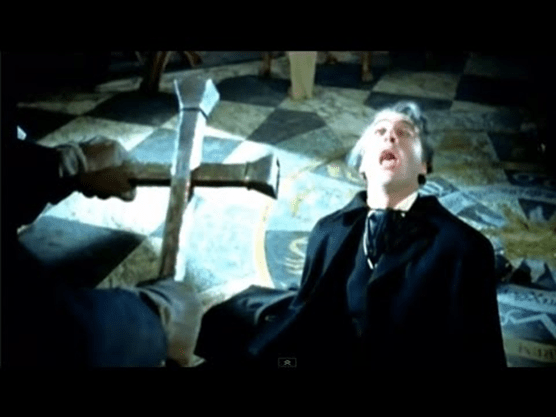
I leap away from the word, hissing like ol’ Christopher Lee when facing a crucifix.

It’s irrational, I know.

It seems to me that improvisation in the theater usually means one of two things.

I love the first meaning. It is the air I breathe in rehearsal. When I am immersed in the script and the character and the moment; when I am listening and alert and listening and watching and listening; every gesture, every glance, every inflection has the immediate potential to send us spinning into places we’ve never been…maybe places where no one has been. Sometimes when we reach those places, we find the character we’re searching for. Sometimes we find bits of ourselves…which may be the same thing. It is thrilling and addictive.

The second meaning though…
…is theater games.

Theatre games are disguised as “fun” and “team-building” and “warm-ups.”
They can involve balls and circles and imaginary boxes.
Notice please, they don’t as a rule involve characters or scripts. I sign on for characters and scripts…not imaginary boxes.

Theater games tend to be just that; games. They usually decay rapidly into competitions won by the clever and the funny. How that furthers our explorations of MacBeth or Willie Loman plumb evades me. I’ve yet to hear MacBeth or Willie Loman described as clever or funny.

(Insert various grumpy comments here. Any will do. “Get offa my lawn!” is trite but appropriate enough.)

I mostly despair of any good rehearsal time lost to theater games.

Mostly…
There are special moments, however…

Once upon an evening, I was involved in a particularly useless “warm-up” game before a rehearsal. The cast formed a circle with one member in the center. The person in the center had to chant; “I’m (state their name) and (state some fact about themselves).” At that point, every person in the circle for whom the fact stated was also true had to abandon their spot in the circle and assume another spot. The center person would try to poach an abandoned spot and whoever was left out would be relegated to the center and would repeat the process.

Whee!

Whee!

Most of the chants proceeded along the lines of;

– “I’m Jane Doe and I went to the movies today.” (scurrying and giggles)
– “I’m John Doe and I drive a Chevy.” (scrambling and guffaws)
– “I’m Becky Doober and I like pizza.” (chasing and chortles)

All very helpful when ferreting out the subtext of a Sam Shepard script.
You can only imagine the utter hilarity that filled the room.
Ri-i-i-i-ght.

This jocular exercise continued until a middle-aged fellow (no, not me) found himself in the center and chanted;

“I’m Joe Doober and I’m a convicted felon.”

The silence of the group…
…was of the soul-searching, exit-locating variety.

The stillness of the group…
…was as profound as a sudden wish for invisibility.

The director broke the meditative moment by chirping;

“Well, that’s enough for tonight. Let’s get started. Set up for Act I.”

Don’t Just Move…Stand There!

I’ve been pondering mobility, or rather the lack of it, as an important element in some horror films.

Normally, we’re a lot more a’feared of a terror whose current location is uncertain and moves mysteriously and quickly (ala the alien in Alien or corona viruses) than we are of a known and fixed enemy like…say…a patch of poison ivy. I don’t fear poison ivy, I avoid it like the scourge that it is. I can’t outrun much on this planet, but I can outrun poison ivy. It can’t “cut me off at the pass”. Viruses however…those little suckers are everywhere! This is the stuff of most horror flicks.

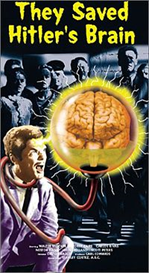
But there are a number of horror films that feature stationary menaces, or menaces that move at glacier-like rapidity. I have viewed a couple of these recently; The Living Head (Mexican), and The Head (German). Two other previously viewed films; They Saved Hitler’s Brain and Donovan’s Brain (both USA), would also fall into this sedentary and thus far inadequately studied category; films about living heads with no bodies (no legs, arms, wings, or driver’s licenses). The writers of these films are required to strive mightily to make these threats plausible since anyone could escape by simply falling down and crawling.

So, how do they do it?

Well, in The Living Head and They Saved Hitler’s Brain, we are shown mesmerized worshipers of the head toting it about from place to place. No one seems to notice or care or check the luggage until it’s too late.

In Donovan’s Brain the titular brain (aka the leading lobe) enforces its desires through emanations (wouldn’t that be a great name for a baseball team or a doo-wop group?)

In The Head it’s as if the writers don’t even try. The threat simply exists as a sideshow to be gasped at. Meh.

Until Brendan Fraser, mummy films had much the same problem. Bandage-bound Boris Karloff and Christopher Lee were not precipitous critters. Writers on these films worked hard to either trip or trap. They would trap their victims in a corner, or just trip them repeatedly, or paralyze them with fear. Fainting was a popular and useful (to the script writer) response. Plausibility fled as the mummy shuffled.

Two films come to mind that actually turned this lack of mobility into a positive. In The Invasion of the Body Snatchers, those malevolent pods can’t move, but are placed where they are most effective by previous victims of the pods. This is effective because of the mathematics of the situation. One victim begets two. Two beget four. Four beget eight. Eight beget… You see the problem. The rapid and devastating multiplication of zombified neighbors and public officials is completely plausible and scary, especially in today’s world of pyramid schemes. Of course one is left speculating whence cometh the terminus ad quo pod.

Personal note; I hate pods to this day. I look at sugar snap peas and shiver.

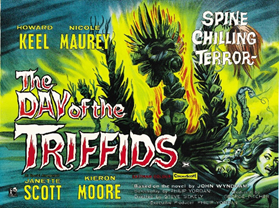
In the beginning of the film The Day of the Triffids, the starring plants apparently cannot move. But after the Earth’s population is blinded by a handy meteor shower, the plants pull up their roots and reveal their slow, but inexorable mobility. The fright factor soars. Kudos for the writer! BUT, look how hard it was to make effective – handy meteor shower? Please.

And that’s my point. Writing is hard work. Why make it harder? Writers should unleash their terrors, not nail their feet (or whatever might pass for feet) to the floor.

Indulge me one more example.

The Monolith Monsters featured mountains that grew quickly (stay with me, now) and fell on you if you were foolish enough to stick around and watch.

Let that sink in…but don’t let it fall on you.

This film reminded me of my one and only visit to Phoenix, Arizona. I looked out the window of my hotel room and saw, not too far away, a butte. Is that the correct term? There were two impressive houses built snugly into the base of the butte. I remarked to the bellman that I would be fearful of living in those houses because of the possibility of gigantic rocks falling on me. He replied that the rocks never fell.

Let that sink in.

I gazed again at the butte surrounded by the Greyhound-Bus-sized boulders that formed the 60-70 foot high slopes of the butte. It reminded me of my California-living friends who blithely dismiss earthquakes as a factor in their lives with; “But the weather’s so nice all the time.”

Blissful denial…perhaps that’s the key to the monolith monsters’ path to success.

Well, it might work for malevolent mountains but it’ll never get you elected president…or…

……give me a moment, I’m letting that sink in.

Droning Tonto and the Atomic Bic

I’m reading a script these days that was originally performed to some acclaim as part of the Humana New Play Festival at Actors’ Theatre Louisville. It reminded me of another Humana New Play Festival experience Janie and I had years ago that was, shall we say, “differently acclaimed.”

I subscribed to Actors Theatre of Louisville for about 24 years. I love this theatre and have enjoyed a number of transcendent evenings over the years. Susan Kingsley and Ken Jenkins in “Childe Byron” was magical. Likewise, “Tobacco Road”, “The Three Musketeers”, “The Sea Gull”, were wonderful, and their production of “The Tempest” was the best I’ve ever seen. There were some head-scratchers along the way (“King Lear” in burkas plumb bewildered me), but overwhelmingly most of the shows were inspiring and entertaining.

So…why did we stop subscribing?

I was working almost every Saturday then. The only performance we could count on attending was the nine o’clock curtain on Saturday nights. I would get away from work about five, we would drive to Louisville, have dinner at the Bristol, make the curtain at nine, get out of the theatre about midnight, and drive home.

Ah, there’s the rub.

That late night drive home became increasingly burdensome. Before dogs took control of our lives and clocks, sometimes we would snuggle in after the show at the Seelbach, have a languorous brunch, and get back home sometime Sunday afternoon. Well-l-l-l, you can fergit dat, O Keepers-of-the-Kibbles!

Janie and I began to question how much pleasure we were getting out of our Louisville theatre habit. Impetuous kids that we are, we debated it for a couple of years. Then there were two productions in that last subscription season that finally convinced us to drop the commitment.

The first production was actually quite well done. It was a gospel concert nominally disguised as theatre. Now, I can enjoy gospel music (or bluegrass, or German lieder) for about fifteen minutes just as well as the next guy, but this was two hours and forty-five minutes more gospel music than the Geneva Conventions probably allow. That night’s drive home was glazed in bitterness and that is the gospel truth.

The other show…

(…shudder, squint, tears begin to flow…)

The other show…

The other show was titled “Beyond Infinity”. It was part of the Humana New Play Festival.

The play consisted of three intertwined (sorta) stories set in the same desert at three different times in history.

One story was of an ill-fated wagon train. Beyond sad. I found myself expecting Ward Bond to come out wailing “Bring out your dead!” (100 trivia points for identifying the geezer reference.)

Mr. Silverheels

The second story was told in a sporadic monologue in monotone by one of ATL’s regular actors whose name eludes me at the moment. He was a gaunt, Sam-Waterston-Abe-Lincoln-Harry-Dean-Stanton-looking fella. For this show he was dressed like Tonto. I don’t mean he was dressed like a Native American. I mean he was dressed like Jay Silverheels in “The Lone Ranger.” Whenever the show’s innate hilarity moaned towards out-of-control, the lights would come up on Tonto. He would gaze at a spot about ten feet over my head (looking for what?…inspiration?…his light?…his lines?…his agent?) and drone. I caught occasional words (kemo sabe, walla wah walla walla walla wah, bibbity bobbity boo) but we were never EVER in the same time zone as a coherent thought.

The third story…

Ah YES-S-S-S-S, the thir-r-rd story…

(Imagine that having just been said by Christopher Lee as Fu Manchu. Go on. Go back and repeat it just that way. You’ll love the way it feels and sounds and you’ll work it into your personal dialogue tomorrow. You’ll owe me.)

Ah YES-S-S-S-S, the thir-r-rd story…

Mr. Oppenheimer

The third story involved J. Robert Oppenheimer and his merry pranksters in the desert working on the atomic bomb. At one stretch in the second act (second act of twelve, as I recall), Oppenheimer is standing in the desert night, holding an address-book-sized volume of the Bhagavad Gita (you can’t make this up!) and a cigarette. His assistant is standing next to him. For ten minutes Oppenheimer reads aloud, translating on the fly, from his tiny book by the light of his assistant’s Bic lighter…you can’t make this stuff up!!

1940’s translation tool

Wait…someone did, didn’t they?

About this moment, Janie, who had shed her shoes and was curled up in her seat in the fetal position, tugged on my sleeve, leaned near and whispered “there are 87 lights up there.” Why not count the lights? What else was there to do?

It ended…as all things eventually must (except baseball games).

We shook the sand from our shoes and shuffled out of the theatre.

Now, one of the rituals involved with living in Lexington, two glasses of wine at dinner, and attending shows in Louisville is the obligatory pre-drive-home bathroom visit. Well, I’m there, at the urinal, “inflagrante delicto” as it were, when the bathroom door is banged open by a three-piece-suit type who angrily announced to the room; “Well, I have been to the desert on a horse with no name!”

I just about missed the urinal.

The Devil Rides Out

Movie night!

The Devil Rides Out (1973) aka The Devil’s Bride.devil rides out-poster

My favorite Hammer horror film; period.

There are so many points of interest.

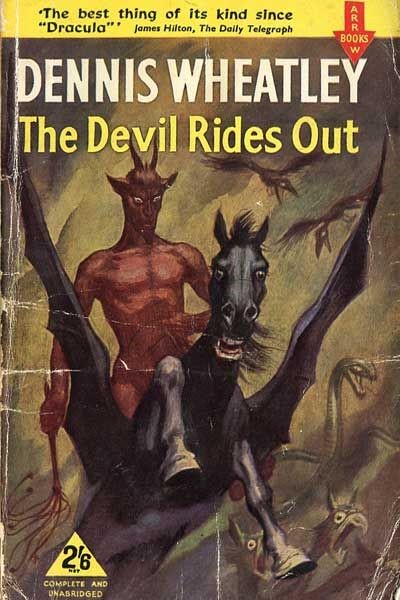
  • The script is an adaptation of a Dennis Wheatley adventure/supernatural novel that features the Duc de Richleau, a modern warrior in opposition to the evil occult. Richleau is every bit as fascinating and urgent as Nayland Smith battling Fu Manchu or Professor Van Helsing pursuing Dracula. Christopher Lee is at his very best in this portrayal.
  • Richard Matheson adapted the novel into the screenplay. Mr. Matheson authored the novels; I AM LEGEND, THE SHRINKING MAN, HELL HOUSE, and SOMEWHERE IN TIME. He also wrote the terrifying short story “Born of Man and Woman” and many of the best episodes of “The Twilight Zone”.
  • The sets are up to the usual Hammer standards for detail and utter lack of clutter and shadows – how do they make that much light come from every direction?
  • devil rides out-bookNiké Arrighi delivers a pathetic (in the best sense of that word) performance as the damsel assailed by satanic forces. It’s quite a change from her portrayal of the free-spirited costume assistant Odile in Truffault’s Day for Night.
  • A wonderfully sinister Charles Gray (Blofeld in several James Bond flicks) dominates (sans cat, however).
  • The conjuring of “The Goat of Mendes” (Satan himself) in the sabbat, the giant tarantula attacking the little girl, the angel of death attacking the protective circle; all impressive and frightening moments.
  • Drop-dead cool cars on tiny English country lanes.
  • Three-piece suits to die for.

Of course the ending is incoherent…but there’s a nice purging inferno.

And the cars are so very cool…I may have previously mentioned that.

I love it.

Don’t Just Move, Stand There!

I’ve been pondering mobility, or rather the lack of it, as an important element in horror films.

Normally, we’re a lot more a’feared of a terror whose current location is uncertain and moves mysteriously and quickly (ala the alien in ALIEN or Zika-carrying mosquitoes) than we are of a known and fixed enemy like, say, a patch of poison ivy. I don’t fear poison ivy, I avoid it. I can’t outrun much but I can outrun poison ivy. It can’t “cut me off at the pass”. Mosquitoes however…those suckers are everywhere! This is the stuff of most horror flicks.

But there are a number of horror films that feature stationary menaces or menaces that move at glacier-like rapidity. I happen to have viewed a couple of these recently; THE LIVING HEAD (Mexican), and THE HEAD (German). Two other previously viewed films; THEY SAVED HITLER’S BRAIN and DONOVAN’s BRAIN (both USA), would also fall into this sedentary and thus far inadequately studied cinematic genre; films about living heads with no bodies (no legs, arms, wings, or driver’s licenses). The writers of these films are required to strive mightily to make these threats plausible since anyone could escape by falling down and crawling.

So, how do they do it?

Well, in THE LIVING HEAD and THEY SAVED HITLER’S BRAIN, we are shown mesmerized worshippers of the head toting it about from place to place. No one they encounter seems to notice or care until it’s too late.

In DONOVAN’S BRAIN the title brain enforces its desires through emanations (wouldn’t that be a great name for a baseball team or a doo-wop group?) In THE HEAD it’s like the writers don’t even try. The threat simply exists as a sideshow to be gasped over. Meh.

Until Brendan Fraser, mummy films had much the same problem. Bandage-bound Boris Karloff and Christopher Lee were not precipitous. Writers on these films worked hard to trap their victims in a corner, or just trip them repeatedly, or paralyze them with fear. Fainting was a popular and useful response. Plausibility fled as the mummy shuffled.

Two films come to mind that actually turned this lack of mobility into a positive. In THE INVASION OF THE BODY SNATCHERS, those malevolent pods can’t move but are placed where they are most effective by previous victims of the pods. This is effective because of the mathematics of the situation. One victim begets two. Two beget four. Four beget eight. Eight beget… You see the problem. The rapid and devastating multiplication of zombie-fied neighbors and public officials is completely plausible and scary.

I hate pods to this day. I look at sugar snap peas and tremble.

In the beginning of the film THE DAY OF THE TRIFFIDS, the titular plants apparently cannot move. But after the Earth’s population is blinded by a handy meteor shower the plants pull up their roots and reveal their slow, but inexorable mobility. The fright factor soars. Kudos for the writer! BUT, look how hard it was to make effective – handy meteor shower? Please.

And that’s my point. Writing is hard work. Why make it harder? I’m thinkin’ writers should unleash their terrors, not nail their feet (or whatever might pass for feet) to the floor.

Indulge me one more example.

THE MONOLITH MONSTERS featured mountains that grew quickly and fell on you if you were foolish enough to stick around and watch.

Let that sink in…but don’t let it fall on you.

This film reminded me of my one and only visit to Phoenix, Arizona. I looked out the window of my hotel room and saw, not far enough away, a butte. Is that the correct term? There were two impressive houses built snugly into the base of the butte. I remarked to the bellman that I would be fearful of living in those houses because of the possibility of gigantic rocks falling on me. He replied that the rocks never fell.

Let that sink in.

I gazed again at the butte surrounded by the Greyhound-Bus-sized boulders that formed the 60-70 foot high slopes of the butte. It reminded me of my California-living friends who blithely dismiss earthquakes as a factor in their lives; “But the weather’s so nice all the time.”

Blissful denial…perhaps that’s the key to the monolith monsters’ path to success.

Oh, and did I mention how much I hate pods?