Tag Archives: Glenn Thompson

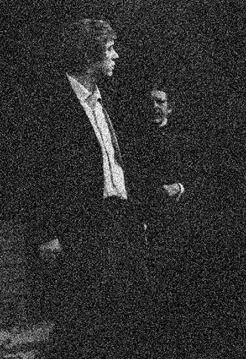
Missing Sidney on This Sunny Day

It’s strange what can trigger a memory.

I have heard my friend and adopted faux-daughter Karyn Czar asking the first reporter’s question at the governor’s press conferences. I’m always proud.

I first met Karyn on stage in a play. Recalling that play, and feeling today’s sun, and the end of the baseball lockout, triggered another happy flashback.

Today now looks to be the opening day for this year’s baseball spring training…at last. It was beginning to look like there would be no spring training and perhaps no season at all thanks to the oligarchs of baseball (the owners AND the players). My friend Sidney Shaw loved to go to the Lexington Legends’ games. He would not have been pleased with the waste of a fine sunny day with no baseball.

I first met Sidney in the same play as I met Karyn.

It was the summer of 1994. It was a production of Measure for Measure in the Lexington Shakespeare Festival when it was still in Woodland Park…and still doing Shakespeare.

I remember admiring Sidney’s ease with the language and the wisdom with which he infused the character he played. I remember being delighted the first night in rehearsal when his character cast aside that wisdom for outraged passion. It made the dramatic moment mean something more…more human. Working with Shakespeare’s foreign-to-us cadences and vocabulary can make an actor forget the humanity of the situations being depicted.

Sidney didn’t forget.

This was a nice production with a bunch of new (to me) actors, most of whom I’ve had the good fortune to work with multiple times over the ensuing years. This group of actors has gone on to mean much to Lexington’s theatre audiences; Karyn Czar, Jeff Sherr, Donna Ison, Eric Johnson, Laurie Genet Preston, Joe Gatton, Glenn Thompson, Spencer Christiansen, Holly Hazelwood, and others.

Ave Lawyer directed. It was my first time to work with Ave and certainly not my last. I’ve moved furniture and learned lines for her in a number of shows since then. It’s always a real nice clambake.

Thus it was with Sidney. He and I shared the stage in four or five productions. He was always good company and I learned something from him in every show.

However, my favorite theatre experience with Sidney was as an audience member for his performance in Death of a Salesman. I watched my friend Sidney disappear into Willie Loman. The growing desperation and evaporating control of Willie Loman was so alien to the Sidney Shaw I knew. It was a remarkable stretch for an actor and Sidney handled it adroitly and broke my heart.

I miss Sidney.

Atticus vs the Sound Effects

Mockingbird 01

Summer outdoor theater is a miraculous thing.

The miracle happens about six months after the summer theater season, in the depths of winter. There is a moment when snow is on the ground and the wind’s a’howlin’. There is a moment on the ninth straight day of no sun at all, a moment when the clothing layers reach seven, when soup sounds real good once too often. At that less-than-golden moment, that summer night you spent on stage the previous year becomes pure gold.

That memory is purged of the heat. The roasted rehearsal on that concrete slab on that Saharan Saturday morning in full costume evaporates from your recall.

Those multitudinous bugs (many of which unsuccessfully screen-tested for the classic film Them and still harbored virulent stage revenge dreams) that you ducked, swatted, and too often swallowed during performances were forgotten.

The memory of the “dead characters’ cocktail lounge” where the actors gathered (after their character in the show was dispatched) to swap lies and hoist a brew or two, that grew in unholy influence during the run of the show until the curtain calls became wobbly bows from which returning to a fully upright position was un-guaranteed…yes, that memory became quaint instead of alarming.

Rain? Lightning? Make-up that melted faster in the heat than it could be applied?

Hecklers?

All vanished…

…erased…

…never happened.

It’s a miracle.

All that remains are memories and tales of;

– Riding a bike home from rehearsal through the reluctantly cooling blanket of dark.
– Humidity and iambic pentameter – a surprisingly compatible combo.
– Bright, pretty, scantily-clad actresses.
– Loud voices and ringing swordplay.
– Large, well-lubricated audiences.
– Stars (thousands) and moons (one per night) and a pool of artificial light in which to speak beautiful words.

That’s all that’s left.

It’s a miracle.

However, some of the non-miraculous is worth remembering as well.

In the summer of 1999, I was lucky enough to play Atticus Finch in To Kill a Mockingbird for the Lexington Shakespeare Festival. My luck expanded to include the fact that I was working with many of my favorite people in the world; Jeff Sherr, Eric Johnson, Anitra Brumagen, Sidney Shaw, Walter May, Glenn Thompson, Michael Thompson… It was a real good time.

Most of the time.

The first act of the show ends with Atticus’ closing statement to the jury. It’s about a ten-minute summation – inspirational and dramatic as hell – an actor’s dream.

On one night’s performance I arose to give the speech to a crowd of 1,000+ people (yes, most likely well-lubricated). As I walked downstage I heard the medivac helicopter approaching from stage right and I knew from previous festival experience that the flight path to the hospital on our stage left would be directly over our stage and loud…certainly louder than me. I took a dramatic pause before commencing the speech…a pause that exactly matched the flight time of the copter.

Mrs. Leasor didn’t raise any fools.

Then I plunged into the speech and was just achieving some momentum when, about five minutes in, I heard the sirens of an ambulance in the distance go ripping through the night.

At about minute eight of the soliloquy, a low-flying private plane rattled over, and as I was winding up for the socko finish, you could hear a freight train moanin’ lonesome through the night.

Mercifully, the cacophony, the speech and the act ended, the lights went dark, and the cast trooped offstage. As I walked off the stage, Eric Johnson was exiting directly behind me and I heard him mumble; “Well, that was certainly a tribute to the combustible engine.”

I wept.

Just Act the Hell Out of It

In the theatre, I have been blessed to work with inspiring directors. Many of them seemed to enter and re-enter my life at times when they could fulfill dual roles; stage director and off-stage mentor. Just as I could not have become the on-stage kings, fools, lawyers, doctors, and errant knights required, so I could not have become the geezer I am today (for better or worse) without their genuine care and, at times, curious advice.

Prof. Charles Dickens lurking on the right

Perhaps preeminent among them, if for no other reason than my bewildered youth at the time, was Charles Dickens.

Yes, that was his real name.

Charles was my adviser at UK. On the Tuesday before my first year at UK, during the “advising” session required before classes began on Monday, Charles filled out my roster of classes (my input was restricted to an awed and tiny “ok”), and informed me that my part-time job at the public library wouldn’t impede my freshman theatre activities since they didn’t cast freshmen anyway…but that I should attend and participate in the Sunday auditions of the season’s opening show (which he was directing) for the experience.

I responded with another tiny; “ok”.

Monday morning, at 9:00, I attended my first college class (Physics: 101 – we learned to bend water with a comb) and was cast in my first show (“Playboy of the Western World”). I was slack-jawed that September at my Physics classmates (“Is that real water?”), and dazzled by my sometimes shabby but always quick cast mates in rehearsal. My path was clear.

That was in the fall of 1969.

In the spring, Charles cast me in his elaborate production of Shakespeare’s “Measure for Measure”. By then, I was a complete “gym rat” in the theatre. Every day began and ended in the Fine Arts Building; the Guignol Theatre, the Laboratory Theatre (now the Briggs), the Green Room, the Scene Shop, the Costume Shop…even an occasional classroom. I lurked in every rehearsal I could find.

Angelo, on the right, acting the hell out of it

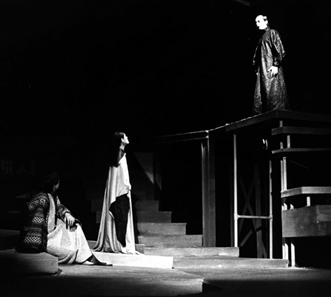
During “Measure”, Charles was deep into his Peter-Brook-THE-EMPTY-SPACE period. I may have learned half of what I know about the theatre listening to him coach actors in these rehearsals. One night, Bill Hayes, a nice actor and UK alumnus brought in by Charles to play “Angelo”, paused rehearsal to question the meaning of the line; “Let’s write ‘good angel’ on the Devil’s horn, tis not the Devil’s crest.” Charles sprang to the stage and took Bill’s script and they pondered…and pondered… Finally Charles handed the script back to Bill with the profound instruction; “Just act the hell out of it.”

Just act the hell out of it?

I had fallen in love with Shakespeare with “Measure for Measure”.

I knew what that line meant!

I could say that line!!

I could change people’s lives with that line!!!

Trump would never be elected if I said that line!!!!

I swore if I ever got the chance…

Well, of course, having sworn, I did, 23 years later.

Me acting the hell out of it in 1993

In 1993, the uber-smart Ave Lawyer cast me as “Angelo” in her production of “Measure”. This production featured a remarkable cast; Eric Johnson, Sidney Shaw, Holly Hazelwood Brady, Laurie Genet Preston, Jeff Sherr, Joe Gatton, Glenn Thompson, Donna Ison, Karen Czarnecki, Spencer Christiansen… WOW!

I had my chance.

I said my line.

I acted the hell out of it.

I changed people’s lives.

I saved the planet…from something.

And dammit, Trump was still elected.

I got up the next day and went to my day job.

Curse of the Starving Class

curse01

Yet another new/old Lexington theatre yarn.

Just to let ya know, if you’re doing a Sam Shepard play and want me to come see it, I’m busy that evening…all the evenings.

If you’d like me to do a Sam Shepard play, I’m more than likely available.

I feel the same way about Pinter, Ibsen, and Albee. I love performing them, but I’m not beatin’ down the doors to watch. It’s a mental defect I guess, but there it is. For me, Godot is simply not worth waiting for.

So, it’s 1987 and Joe Ferrell is directing Sam Shepard’s The Curse of the Starving Class for Actors Guild Lexington (usually referred to as “AGL”). This is when AGL was performing in a rickety building in downtown Lexington called the LMNOP building (usually referred to as “LMNOP” – go figger). The LMNOP moniker stemmed from its life as “Club LMNOP”, a legendary night club in its day. By 1987 this building had been rode hard and put up wet to dry. Creaked? No, it shrieked. It wobbled. It was seasonal, which is an apt euphemism for little discernible heat and air. But the rent was right and in the theatre, that usually rules (remind me to bore you with my “theatre verismo” experience one January doing Terra Nova in the basement of a downtown Lexington restaurant — all of Antarctica in a room that sat 50 people – yes, I have pictures).

Well, I was hot for this project. I had worked with Joe on Shepard’s Buried Child a couple of years earlier and it had been a very satisfying time. In that play, I portrayed a raging psychotic single-amputee who was tormented in the second act by his own brother (played by Vic Chaney) who used his own his prosthetic leg as a club against him. It was a laugh-a-minute riot. I was proud of the portrayal even though it took my knee a year to fully recover. I was hungry for another bit of fluff like that.

My previous role for Joe was as a gay, double-AK-amputee Vietnam War vet. It was intriguing to me to get an opportunity to finally do a show with Joe in which I could use all my limbs.

Oh sure, the script of Curse called for a scene with complete male nudity, but it wasn’t my character and surely Joe would find a work-around to avoid going that far in my beloved 1987 Lexington, where I was dealing with the public every day in my retail career……surely…………surely.

Well, it was a remarkable cast and crew. It included Joe Gatton, Martha Campbell, Glenn Thompson, and Carol Spence, all of whom I had worked with numerous happy times.

It also included Kevin Haggard. Kevin and I had never worked together before and we’ve not worked together since. Dammit. In Curse Kevin played my son in a strikingly (emphasis on “strike”) abusive father/son relationship. I tend to work quickly in the rehearsal process – Kevin works more thoughtfully. I didn’t know that at the time. The first two weeks of rehearsal I kicked his ass all over the stage. I feared I might kill him if he didn’t start reacting with a bit more alacrity and how was I gonna explain that to his mother.

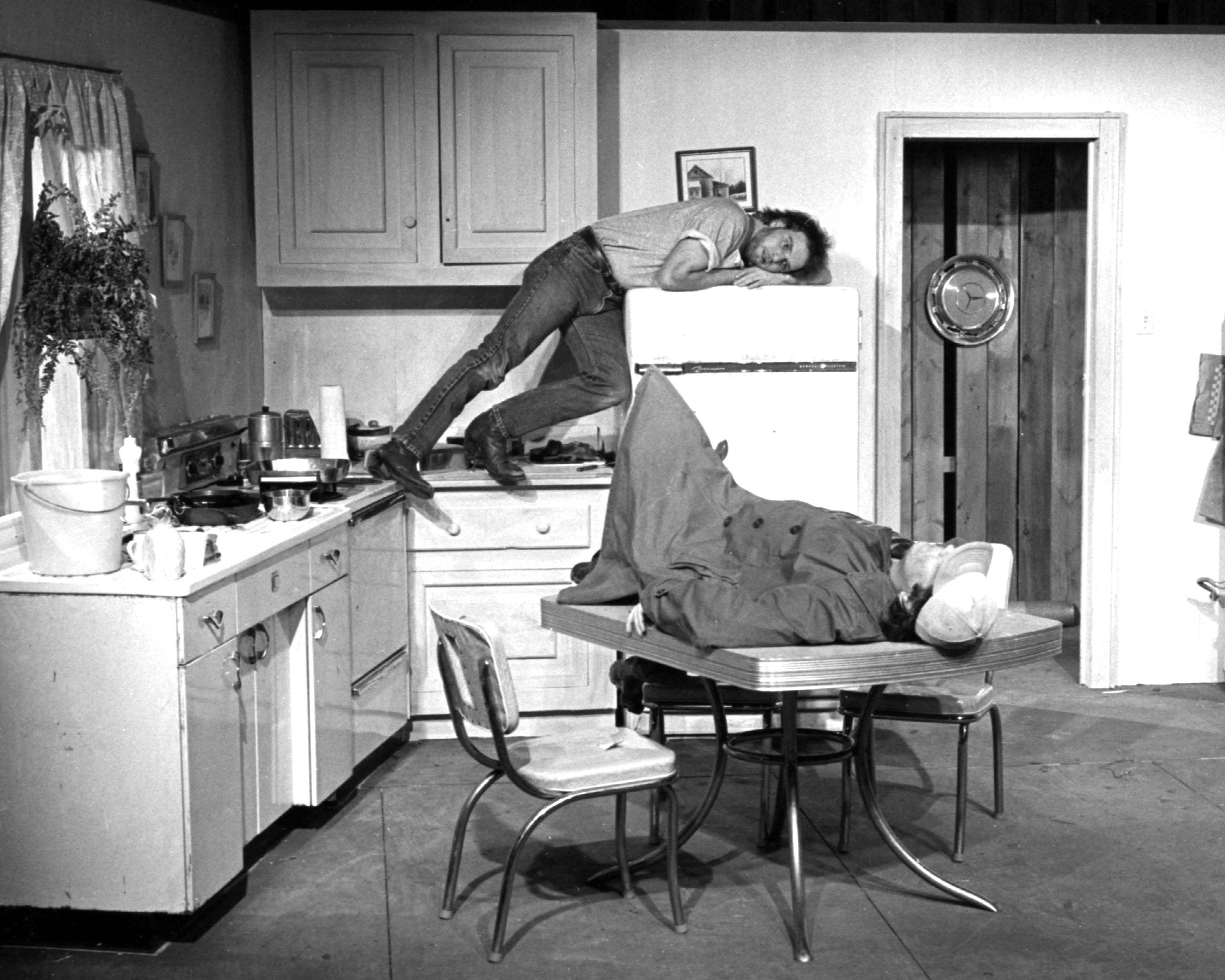
Not to worry; from the third week of rehearsal through closing night, Kevin’s character grew every night. I was impressed and bit scared for my own well-being. By opening night I discovered in one scene Kevin had ascended the heights of our kitchen and assumed a manic 45 degree angle against the fridge. I was supine on the kitchen table at the time and chaos was eminent.

It was a fine moment.

curse05
It was a fine moment

It was Kevin’s character that had to deal with the nude scene.

As the rehearsals proceeded, it was sometime in week three that it dawned on me that Joe was dealing with the nude scene by simply doing it as written.

Whatta concept!

What made the scene more special was that Kevin had to carry a sheep during it. This was after a first act scene in which he took his sister’s 4-H project “How to Butcher a Cow” chart, tossed it on the floor, and pee’d on it. He was an endearing character.

I was envisioning letters to the editor at least, or pitchforks and torches at worst. Didn’t happen. Instead, we played to great reviews and sold-out houses. Go figger.

About six months after the show closed, two gentlemen came to see me at work to discuss Liquor Barn’s participation in the United Way. One of the gentlemen noticed a picture on my office wall of one of my shows. He remarked; “My wife and I go to the theatre often. Last year we saw a play where a character actually pissed on the stage!” I gave him my biggest grin, shook his hand, and said; “I played that boy’s father!!”

That was the last I heard from the United Way that year.

But all in all, Curse of the Starving Class was a good experience.

  • Big audiences.
  • The building didn’t collapse.
  • I got to work with Cambo the Clown and his “Ya-Ya Juice” (another story for another time).
  • I didn’t have to deal with the sheep.

Baa-a-a-a.