Tag Archives: Godzilla

Japanese Noir…Kurosawa-Style

Akira Kurosawa is perhaps best known for his mighty Shakespearean films; RAN (1985), THE HIDDEN FORTRESS (1958), and THRONE OF BLOOD (1957). His Samurai Trilogy was exciting. His SEVEN SAMURAI (1954) and YOJIMBO (1961) inspired a whole genre of European westerns, plus a little flick called STAR WARS (1974). His RASHOMON (1950) is a masterpiece of storytelling.

But that storytelling skill is also happily evident in his less grandiose crime dramas; STRAY DOG (1949), LOWER DEPTHS (1957), and tonight’s HIGH AND LOW (1963).

In HIGH AND LOW, we see a Yokohama in the swirl of Japan’s amazing recovery from WWII. It’s not the Japan of Lafcadio Hearn, Shinto temples, and tea ceremonies. This is a roiling time of factories, trains, smokestacks, efficiencies, and cutthroat board battles. It is a time to make fortunes…for yourself……or for others. The income gap is wide and widening…sound like anywhere else you’re living in today?

A brutal kidnapping occurs.

Toshiro Mifune is pathetic as he agonizes over whether to destroy his privileged life to possibly save the life of the child.

Tatsuya Nakadai as Chief Detective Tokura and his sweating team of investigators, salvage and assemble clues leading through murder and drug-infested dens that will never be documented in haiku, till they inevitably run the kidnapper to capture.

 Tsutomu Yamazaki as the kidnapper confronts Mifune;

“I’m not interested in self-analysis. I do know my room was so cold in winter and so hot in summer I couldn’t sleep. Your house looked like heaven, high up there. That’s how I began to hate you.”

Allow me to paraphrase Thornton Wilder here;

The difference between enough money and not enough money is really quite small…but it can change the world. The difference between enough money and a whole lot of money is also quite small…but it too…can change the world.

It crept into my Hearn/Shinto/tea/haiku mind as I watched the film, that perhaps we should consider Thornton Wilder and the kidnapper the next time we condescend to ask presidential candidates about raising the minimum wage.

On a lighter note, I was arrested by a cameo performance by Ikio Sawamura as an expert in the sound of various trolleys in Yokohama. Mr. Sawamura had a long film career in a number of Kurosawa’s films, and also appeared in a number of films that made a serious cultural difference in the world of a wide-eyed young film-goer in Kentucky;

1963-KING KING VS GODZILLA (witch doctor) and ATRAGON (taxi driver)

1964-MOTHRA VS GODZILLA (priest) and GHIDORAH, THE THREE-HEADED MONSTER (honest fisherman)

1965-FRANKENSTEIN VS BARAGON (man walking dog)

1966-THE WAR OF THE GARGANTUAS (fisherman #1) and EBIRAH, HORROR OF THE DEEP (elderly slave)

1967-KING KONG ESCAPES (Mondo islander)

1968-DESTROY ALL MONSTERS (old farmer)

1969-ALL MONSTERS ATTACK (bartender)

1975-TERROR OF MECHOGODZILLA (silent butler)

Whatta resumé!
Japanese Noir

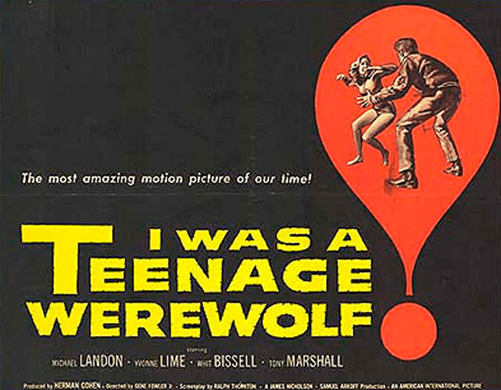
I watch some fairly awful movies with great regularity and glee. Nothing could promise less and truly deliver accurately on the promise than movies like The Giant Gila Monster or I Was a Teenage Werewolf. I maintain to this day that Gila Monster could have been nominated for an Oscar for best song in a movie. Hey, sure the song (chant?) is cheesy as hell, but it was a slow year for movie music. Gigi was better? I’m not so sure.

And Teenage Werewolf has points of interest.

  • Teenage boys are known to fret over their complexion and when they might start needing to shave. This flick posits a bizarre take on both anxieties.
  • Plus, watching Michael Landon struggle to bring life to this title character by grunting his lines (human and lycanthropic) makes the viewer ponder if this early acting challenge aided or impeded his mature dramatic efforts (Little Joe in Bonanza and the dad in Little House on the Prairie). It’s a head-scratcher for 30-40 seconds.
  • If this story were remade today, it would probably include a scene in which Nick Saban would pay a recruiting visit to our high-school werewolf promising to change Alabama’s football schedule to all night games.

What delights.

I also watch Japanese movies with regularity. They usually fall into one of two categories;

  • Happy foolishness featuring Godzilla or his runnin’ (actually flyin’) buddies Mothra, Rodan, Ghidra, et al.
  • Seriously serious films directed by Akira Kurasawa (the man is a god to me).

But tonight’s 1961 Japanese film is a new experience for me. None of the actors are wearing rubber suits, Tokyo is not destroyed, Toshiro Mifune is not in the cast, and thousands of mounted warriors with helpful identifying flags are not raising the dust.

Zero Focus (I haven’t a clue as to the meaning of the title) is beautifully directed by Yoshitaro Nomura. I prowl the overnight offerings of Turner Classic Movies just in hope of finding flicks like this.

If you are a fan of film noir and Hitchcock, this is your meat.

  • It’s in black and white.
  • There are trains.
  • The characters speak Japanese, but the language of the film is “bleak”. I happen to be fluent in bleak – I suppose it’s from doing too many Sam Shepard plays and walking out on too many productions of Waiting for Godot (patience is not my forté).
  • There are trains.
  • The plot twists and then twists again.
  • The characters play for keeps. Those who die stay dead, though occasionally we wonder.
  • Did I mention the trains?
  • Segments of Japanese post-war society of which I was totally ignorant are explored (dredged?).
  • I cared about every one of the characters in this story.

This is fine storytelling.

The acting is also fine. Excuse me for throwing some names at you, but these ladies are new to me and I was so very impressed.

  • Yoshiko Kuga is plain, pathetic, smart, and determined.
  • Hizuru Takachino is polished and desperate.
  • Ineko Arima is heartbreaking……………….just heartbreaking.

These women drive the film. How unusual is that for 1961?

Behind these performances, the music is gripping.

I was so taken by this film by Yoshitaro Nomura, I proceeded to watch reputedly his best film; The Castle of Sand. Lucky me.

The Castle of Sand contains another satisfying quota of “noir” elements.

  • It pairs an older/wiser investigator with a younger/more energetic partner (I’m hearing the theme music from The Streets of San Francisco now). They work on the case in question separately and come back together to compare their discoveries. Those discoveries are meager, but spark progress in each other through this cross-pollination. Yes, there are some “Eureka!” moments, but not the usual Hollywood kind. Mind you, I’m not knockin’ Hollywood “Eureka!” moments. They’re usually pretty exciting storytelling. But it’s intriguing to see these two hard-working, sweating, high-integrity guys tease just enough new information to keep their investigation flickering.
  • The film has bar scenes, dining car scenes, and police headquarters interview scenes. Check, check, and check.
  • Again, it has trains. I know that sounds strange but this is always good for me. It makes me a passenger with no control. I am caught in a powerful, loud machine hurling me towards the next chapter in the adventure at hand. Gulp.

The film does not have Ginzu knives.

But wait! There’s more!!

Unlike Zero Focus, this film is in color. Mr. Nomura uses that color to exploit the beauty of rural Japan. Imagine if the Ingmar Bergman of Smiles of a Summer Night had shot a film in rural Kentucky in early summer. The vistas are impossibly green and people stand small in them. The roads/trails are generally straight and so are the people. Integrity is high – tolerance is low. Hospitality is ubiquitous – charity is rare.

The acting in this film is perhaps not as uniformly fine as in Zero Focus, but the portrayal of the older detective by Tetsuro Tanba (fellow James Bond aficionados will remember Mr. Tanba as Tiger Tanaka in You Only Live Twice) is very nice.

The treasure in this film is the remarkable way the resolution is revealed and, as in Zero Focus, the intriguing use of music. Our detectives apply for a warrant to arrest their suspect. To do so, they must present their case to an assembly of police officials. As they tell their story we see their story in painful and lush flashback. As they speak and we watch, everything is underscored by a piano concerto written and played in concert by our prime suspect. The camera smoothly and logically and relentlessly moves from police conference to rural saga to concert performance. I could not look away. The plot twists as the story is unveiled are effective and startling………and plausible.

This is a gem.

Halloween Euro-Trash

It’s Halloween season and it’s movie night!

I’m immediately hooked solid when a flick’s philosophical underpinnings are spelled out in the opening dialogue and are obviously words to live by.

In tonight’s film, a casual chitchat suggests;

“Dealing with a murderer is not only repugnant, but it can lead to…complications.”

While I accept the probable veracity of the statement, I have yet to have this sentiment pop up in any conversation. That’s most likely for the best. I suspect a life too-filled with “murderer”, “repugnant”, and “complications” in its language is directly linked to a reduced life expectancy.

But in a horror flick? We’re off and running!

Now that line sounds like something Charlie Chan might have said. But no, it’s one of the many pearls of wisdom included in the Euro-trash classic; The Hunchback of the Morgue. This is another inexplicably overlooked candidate for adaptation to a Broadway musical.

Check out this snappy exchange;

“Sulphuric acid!”

“Yes. We’ll be using it to dispose of the anatomical parts and other organic things.”

Let’s ponder that for a moment, shall we? …”other organic things”… what could “other organic things” possibly be? And do we really want to know?

This film has many of the basic elements of great bad film-making;

  • A secret cave with shiny, jagged rock walls but a perfectly flat floor (only in the movies can such a geologic miracle exist).
  • A fully functional mad doctor laboratory (with much gurgling and bubbling equipment) in said secret cave.
  • Sporadic electricity (besides most of the acting). This state-of-the-art laboratory is lit by torches, but the electrical equipment works – go figure.
  • Whispering. Everyone in the film whispers. Everyone, everywhere, all the time. I’m guessin’ the actors are actually moonlighting golf commentators.
  • A hunchback with a foot fetish and the ability to climb tile-roofs like Cary Grant in To Catch a Thief.
  • A student nurse whose apartment has dead animals and a Modigliani hanging on her walls. Clearly student nurses make damn good money in Europe and have a remarkable range in taste.
  • Grave-robbing, decapitation, artificial life (besides most of the acting).

The only thing missing in this epic is Godzilla!

Great bad Halloween fare

I loved it.

Magical Legends & Legumes

Movie night!

INTO THE WOODS.

I liked it…a lot.

Meryl Streep is impossible to look away from – nothing new in that. I am always amazed at the energy, imagination, and range of Ms. Streep in the projects she chooses. Hell, I think I was the first one standing at the opening night of the film version of MAMMA MIA at the Kentucky Theater. It was a brave choice and I loved her performance.

The songs in this show are engaging and clever – nothing new in that. It’s Stephen Sondheim.

The stories Sondheim mashed up to create the narrative of INTO THE WOODS are some of the most exciting stories ever told…and told and told. Again, nothing new here. Giants, witches, philandering princes, magical legumes, senior-citizen-devouring wolves; this is the stuff of legends. Oh wait, they are legends.

I will watch this film for the rest of my life, perhaps in bits and pieces as I stumble across it while channel-surfing, but I’ll watch it from now on and happily so.

But let’s be honest. There’s nothing new here. Nothing has been added to the luster of Meryl Streep, Stephen Sondheim, or Little Red Riding Hood. It’s simply cultural comfort food.

And I’m OK with that. I watch old films over and over, and indulge in cutting-edge speculations as to what Frank Capra could have done with a Godzilla film. But I also wonder what would happen if Mr. Sondheim wrote something totally new…specifically for film…specifically for Meryl Streep. That, for me, would be wandering into a woods wonderful and unknown and scary and thrilling.

I’d like that…a lot.

Euro-Trash and “Other Organic Things”

It’s Movie Night and I’m hooked solid when the flick’s philosophical underpinnings are spelled out in the opening dialogue and are clearly words to live by.

“Dealing with a murderer is not only repugnant, but it can lead to…complications.”

I have always found this to be true.

Doesn’t that line sound like something Charlie Chan might have said? But no, it’s one of the many pearls of wisdom included in the Euro-trash classic; The Hunchback of the Morgue. This is another inexplicably overlooked candidate for adaptation to a Broadway musical.

Check out this snappy exchange;

“Sulphuric acid!”

“Yes. We’ll be using it to dispose of the anatomical parts and other organic things.”

Let’s ponder that for a moment, shall we? …”other organic things”… what could “other organic things” possibly be? And do we really want to know? Pass the acid, please.

This film has so many of the basic elements of great bad film-making;

  • A secret cave with jagged rock walls but a perfectly flat floor (only in the movies can such a geo-miracle exist).
  • A fully functional mad doctor laboratory (with much gurgling and bubbling equipment) in said secret cave.
  • Sporadic electricity (besides most of the acting). This state-of-the-art laboratory (with much gurgling and bubbling equipment) is lit by torches – go figure.
  • Whispering. Everyone in the film whispers. Everyone, everywhere, all the time. I’m guessin’ the actors are actually moonlighting golf commentators.
  • A hunchback with a foot fetish and the ability to climb tile-roofs like Cary Grant in To Catch a Thief.
  • A student nurse whose apartment has dead animals and a Modigliani hanging on her walls. Clearly student nurses make damn good money in Europe and have a remarkable range in taste.
  • Grave-robbing, decapitation, artificial life (besides most of the acting).

The only thing missing is Godzilla!

I loved it.

Radioactive Emanations

Movie night!

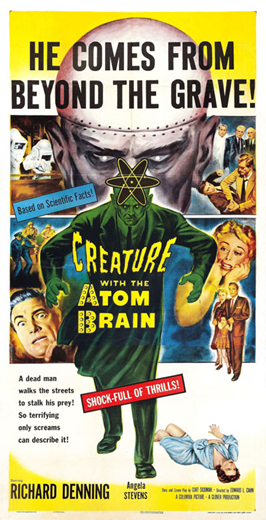
Tonight’s viewing features two – count ‘em! – two classics; THE CREATURE WITH THE ATOMIC BRAIN and GODZILLA VS. THE SEA CREATURE.

Always snappy

THE CREATURE WITH THE ATOMIC BRAIN features snappy dialogue exchanges like;

Detective; “What’s that?”

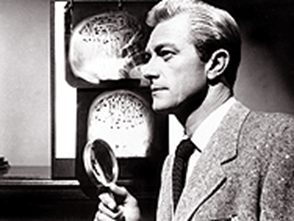
Professor (played by the always snappy Richard Denning); “It’s a Geiger counter – I’m searching for radioactive emanations.”

I’m pretty sure from the title he’s gonna find some.

Radioactive Emanations – weren’t they the opening act for the Strawberry Alarm Clock back in 1978?

This flick features radio-controlled, radioactive zombies (the worst kind) working for a gangster. It’s a viable business plan. I wish I had thought of it, but then I don’t possess an atomic brain…and I’m not a gangster.

I suspect part of the appeal of living dead/zombie storylines to film producers is the money saved in costuming. For the most part the zombies can wear their own clothes as long as they haven’t been laundered recently. No rubber monster suits are required, unlike our second masterpiece.

GODZILLA VS. THE SEA CREATURE is a big lizard flick starring Godzilla (the Cary Grant of big lizards), Ebirah (a monster lobster), Mothra (a serene destroyer in the sky), and those miniature twin singers (Walter Tunis has all their albums). These tiny and irritating singers appeared in several Japanese monster films featuring Mothra. The original singers were a real life duo called The Peanuts. In this film however, The Peanuts are out and the fairy singers are played by another equally grating duo called The Pair Bambi (Walter used to date them).

Collect them all

I can’t believe I know things like this.

But…THIS is why movies were invented; rubber suits, tiny lousy singers, giant lobsters, and radioactive emanations.

I get all tingly.

Godzilla, Suspenders, & Short Pants

Movie night and my personal Japanese film odyssey continues.

This time I’m moving from riveting film noir to rubber-suited nuisances and from the remarkable to the regrettable. Tonight’s delicacy is Godzilla vs. Hedorah (aka Godzilla vs. the Smog Monster). Do you suppose there might be a sequel; Godzilla Visits the Island of the Plastic Bags?

Hedorah looks like a cross between a giant tadpole and something unfortunate you might find on your shoe after walking the dog…oh…and with bloodshot eyes. One of Hedorah’s main weapons seems to involve projectile vomiting. I’m usually a pretty open-minded kinda guy but I’m thinkin’ deliberate hurling does not go on the smiling side of the scoreboard for this epic. Ew-w-w-w-w.

I’m notoriously unashamed to admit my fondness for Godzilla flicks but there are some elements that regularly pop up in the films that are simply bewildering in polite society. This film has several of ‘em;

  • There’s a precocious child in suspenders and short pants. Wrong.
  • Godzilla is portrayed as a friend to humanity. Completely wrong.
  • There are scenes on Mt. Fuji for no reason at all. Film-makers seem to love shooting mountains. I’m guessin’ it’s because mountains are consistent in their line readings and always hit their mark.

Mercifully, Son of Godzilla is not in this flick, nor have there been any scientists in school-bus-yellow jumpsuits. School-bus-yellow jumpsuits…why not just write “EAT ME” on their backs? Perhaps Godzilla, Hedorah, Mothra, et. al. lack reading skills.

The film is given an unfortunate artificial jolt by a psychedelic (non-geezers, you may have to google that word) night club sequence that features hard-driving songs by The Honey Knights and The Moon Drops (Adam Luckey and Walter Tunis have all their albums) and random, drifting skeletons for no purpose useful to the telling of this tale. You can do that kind of stuff when you’re being psychedelic.

Oh yeah, the film’s bad, it’s real bad. I of course cherish every minute of it.

Well, maybe not every minute – suspenders and short pants – a terrible thing to do to any child.

Japanese Noir

Movie Night!

I watch some fairly awful movies with great regularity and glee. What could possibly promise less and truly deliver on the promise than THE GIANT GILA MONSTER or I WAS A TEENAGE WEREWOLF?

I also watch Japanese movies with regularity. They generally fall into two categories;

  • Delightful foolishness featuring Godzilla or his friends Mothra, Rodan, Ghidra, et al.
  • Seriously engaging films directed by Akira Kurasawa (the man is a god to me).

But tonight’s 1961 Japanese flick is a new experience for me. None of the actors are wearing rubber suits, Tokyo is not destroyed, Toshiro Mifune is not in the cast, and thousands of mounted warriors are not raising the dust.

ZERO FOCUS (I haven’t a clue as to the meaning of the title) is beautifully directed by Yoshitaro Nomura. I prowl the overnight offerings of Turner Classic Movies just in hope of finding flicks like this.

If you are a fan of film noir and Hitchcock, this is your meat.

It’s in black and white. There are trains. The characters speak Japanese, but the true language of the film is “bleak”. I am fluent in bleak. There are trains. The plot twists and twists again. The characters play for keeps. Those who die stay dead, though sometimes we wonder. There are trains. Segments of Japanese post-war society of which I was totally ignorant are explored (dredged?). I cared about every one of the characters in this story. This is very fine storytelling.

Did I mention there are trains?

The acting is also very fine. Excuse me for throwing some names at you, but these ladies are new to me.

  • Yoshiko Kuga is plain, pathetic, smart, and determined. That can’t be easy to do.
  • Hizuru Takachino is polished and desperate.
  • Ineko Arima is heartbreaking……………….heartbreaking.

These women drive the film. How unusual is that for 1961?

Ko Nishimura and Yoshi Kato provide mighty support.

Behind these performances, the music is gripping.

I understand Mr. Nomura’s best film is THE CASTLE OF SAND. I gotta find that.