Tag Archives: Sam Shepard

Game-Stopper!

The word “improvisation” in the theater sends me cowering to the nearest corner.
S-s-s-s-s-s-s!

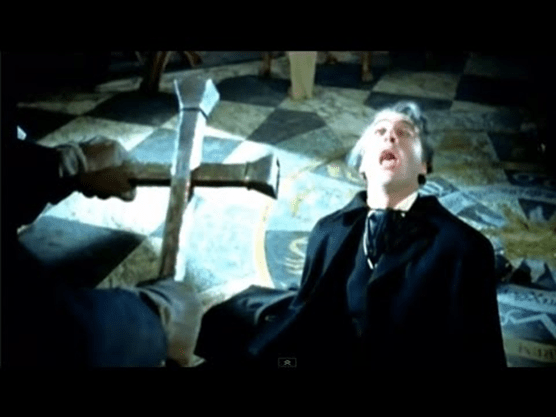
I leap away from the word, hissing like ol’ Christopher Lee when facing a crucifix.

It’s irrational, I know.

It seems to me that improvisation in the theater usually means one of two things.

I love the first meaning. It is the air I breathe in rehearsal. When I am immersed in the script and the character and the moment; when I am listening and alert and listening and watching and listening; every gesture, every glance, every inflection has the immediate potential to send us spinning into places we’ve never been…maybe places where no one has been. Sometimes when we reach those places, we find the character we’re searching for. Sometimes we find bits of ourselves…which may be the same thing. It is thrilling and addictive.

The second meaning though…
…is theater games.

Theatre games are disguised as “fun” and “team-building” and “warm-ups.”
They can involve balls and circles and imaginary boxes.
Notice please, they don’t as a rule involve characters or scripts. I sign on for characters and scripts…not imaginary boxes.

Theater games tend to be just that; games. They usually decay rapidly into competitions won by the clever and the funny. How that furthers our explorations of MacBeth or Willie Loman plumb evades me. I’ve yet to hear MacBeth or Willie Loman described as clever or funny.

(Insert various grumpy comments here. Any will do. “Get offa my lawn!” is trite but appropriate enough.)

I mostly despair of any good rehearsal time lost to theater games.

Mostly…
There are special moments, however…

Once upon an evening, I was involved in a particularly useless “warm-up” game before a rehearsal. The cast formed a circle with one member in the center. The person in the center had to chant; “I’m (state their name) and (state some fact about themselves).” At that point, every person in the circle for whom the fact stated was also true had to abandon their spot in the circle and assume another spot. The center person would try to poach an abandoned spot and whoever was left out would be relegated to the center and would repeat the process.

Whee!

Whee!

Most of the chants proceeded along the lines of;

– “I’m Jane Doe and I went to the movies today.” (scurrying and giggles)
– “I’m John Doe and I drive a Chevy.” (scrambling and guffaws)
– “I’m Becky Doober and I like pizza.” (chasing and chortles)

All very helpful when ferreting out the subtext of a Sam Shepard script.
You can only imagine the utter hilarity that filled the room.
Ri-i-i-i-ght.

This jocular exercise continued until a middle-aged fellow (no, not me) found himself in the center and chanted;

“I’m Joe Doober and I’m a convicted felon.”

The silence of the group…
…was of the soul-searching, exit-locating variety.

The stillness of the group…
…was as profound as a sudden wish for invisibility.

The director broke the meditative moment by chirping;

“Well, that’s enough for tonight. Let’s get started. Set up for Act I.”
Broken Things

I’m old enough now to have been several things. Over the last six decades, I’ve been a library clerk, a husband, a retail store manager, a stepfather, a student, an advertising manager, a wine consultant, a friend, a singer in musical theatre, a husband again, a Frisbee artiste, a party planner, a government relations director, a voracious reader, the president of a chain of liquor stores, a book collector, a singer in a rock-n-roll band (the whitest soul-singer you’ve ever seen), and……an actor/storyteller.

I’ve been pretty good at some of these things. Others? Well…I still throw a decent Frisbee.

During the “ugly hour” (thank you, David Bromberg for that troubling concept) of looking in the morning mirror, the person I most often see is that last listed; actor/storyteller. It feels like I have consumed a huge chunk of my life by instantly pondering in every situation; “How am I gonna tell other people about this?”

Storytelling and acting…it’s my comfortable place.

So…

I’m remembering a time when I was rehearsing a play.

It was Athens West Theatre’s production of The Christians by Lucas Hnath and I was spending my evenings rehearsing a gripping and relevant script with a literate and incisive director and a cast whose passion humbled me.

It was a real good time.

What enhanced the rehearsal process were the spaces in which we rehearsed.

We rehearsed in various rooms at a private school in Lexington. One night we would be in the school’s cafeteria, the next in the school’s music room, the next in the school’s theatre office. The spaces were warm and clean and neat. Everything worked. Everything pointed to civility and creativity. Their hygienic competency inspired us to leave the spaces as pristine as we found them. That was their message to us; “Work. Create. Dream. Respect those that follow.”

I have worked in rehearsal spaces (and theatres themselves) that were far from pristine. In one space we tried to create an Antarctic setting in the basement of a downtown building that was thermostat-challenged in January (I assure you imagining the cold was no problem at all). In another, we rehearsed Sam Shepard and Sherlock Holmes in a building that shook with every passing car and the dust hovered in the air looking for a parking spot in our lungs. Another space nourished our creative efforts with water fountains that spewed burnt-siena-tinged fluids. Other spaces saluted our presence with deliberate car horns. Shakespeare was challenged by rain and heat and barking dogs (sometimes simultaneously).

Our storytelling efforts were not improved in these broken environments.

Striving to create, surrounded by broken things.

It reminds me of a Christmas I witnessed where a six-year-old boy received a bonanza of presents. Every complicated gizmo advertised on TV that holiday season was unwrapped Christmas morning. He was delighted and overwhelmed…for a day. By the next day, the charms of every toy and gizmo had faded. The six-year-old with six-year-old motor skills had compromised every item in some way. He sat in his play space pitifully surrounded by things that did not work as they should. They were all broken…in some way.

Surrounded by broken things.

What good can possibly come from that?

I was envious of the bubble created by the private school. I wanted to play with all the guitars and drums. I wanted to share their meals and thrill to their daily discoveries. The message to the students was clear; “We don’t expect you to merely survive. We expect you to thrive. We expect you to make things better.”

But outside the bubble…?

What about the broken things elsewhere?

Bridges, water slides, county water systems, sinking cities, neighbors sinking into substance abuse, and teenagers carrying weapons of mass destruction and brains that will not be fully developed for another five to ten years…

We are surrounded by broken things.

We are not improved by the messages those broken things impart.

We must fix the broken things for everyone.

It’s not dramatic…or sexy…or rapid. I’m old and may not see the harvest of such a mending, but I know it’s the better path and I’ll sleep better and tell a better story if we’re heading in a better direction.

Work.

Create.

Dream.

Respect those that follow.

This is not hard.

Japanese Noir

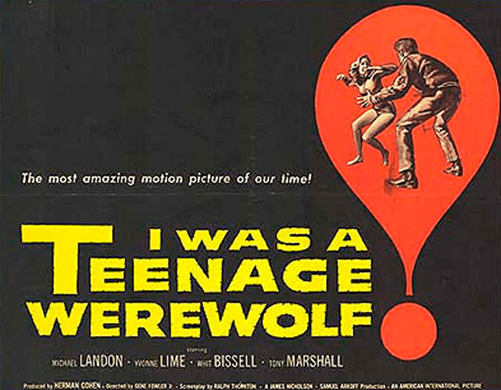
I watch some fairly awful movies with great regularity and glee. Nothing could promise less and truly deliver accurately on the promise than movies like The Giant Gila Monster or I Was a Teenage Werewolf. I maintain to this day that Gila Monster could have been nominated for an Oscar for best song in a movie. Hey, sure the song (chant?) is cheesy as hell, but it was a slow year for movie music. Gigi was better? I’m not so sure.

And Teenage Werewolf has points of interest.

  • Teenage boys are known to fret over their complexion and when they might start needing to shave. This flick posits a bizarre take on both anxieties.
  • Plus, watching Michael Landon struggle to bring life to this title character by grunting his lines (human and lycanthropic) makes the viewer ponder if this early acting challenge aided or impeded his mature dramatic efforts (Little Joe in Bonanza and the dad in Little House on the Prairie). It’s a head-scratcher for 30-40 seconds.
  • If this story were remade today, it would probably include a scene in which Nick Saban would pay a recruiting visit to our high-school werewolf promising to change Alabama’s football schedule to all night games.

What delights.

I also watch Japanese movies with regularity. They usually fall into one of two categories;

  • Happy foolishness featuring Godzilla or his runnin’ (actually flyin’) buddies Mothra, Rodan, Ghidra, et al.
  • Seriously serious films directed by Akira Kurasawa (the man is a god to me).

But tonight’s 1961 Japanese film is a new experience for me. None of the actors are wearing rubber suits, Tokyo is not destroyed, Toshiro Mifune is not in the cast, and thousands of mounted warriors with helpful identifying flags are not raising the dust.

Zero Focus (I haven’t a clue as to the meaning of the title) is beautifully directed by Yoshitaro Nomura. I prowl the overnight offerings of Turner Classic Movies just in hope of finding flicks like this.

If you are a fan of film noir and Hitchcock, this is your meat.

  • It’s in black and white.
  • There are trains.
  • The characters speak Japanese, but the language of the film is “bleak”. I happen to be fluent in bleak – I suppose it’s from doing too many Sam Shepard plays and walking out on too many productions of Waiting for Godot (patience is not my forté).
  • There are trains.
  • The plot twists and then twists again.
  • The characters play for keeps. Those who die stay dead, though occasionally we wonder.
  • Did I mention the trains?
  • Segments of Japanese post-war society of which I was totally ignorant are explored (dredged?).
  • I cared about every one of the characters in this story.

This is fine storytelling.

The acting is also fine. Excuse me for throwing some names at you, but these ladies are new to me and I was so very impressed.

  • Yoshiko Kuga is plain, pathetic, smart, and determined.
  • Hizuru Takachino is polished and desperate.
  • Ineko Arima is heartbreaking……………….just heartbreaking.

These women drive the film. How unusual is that for 1961?

Behind these performances, the music is gripping.

I was so taken by this film by Yoshitaro Nomura, I proceeded to watch reputedly his best film; The Castle of Sand. Lucky me.

The Castle of Sand contains another satisfying quota of “noir” elements.

  • It pairs an older/wiser investigator with a younger/more energetic partner (I’m hearing the theme music from The Streets of San Francisco now). They work on the case in question separately and come back together to compare their discoveries. Those discoveries are meager, but spark progress in each other through this cross-pollination. Yes, there are some “Eureka!” moments, but not the usual Hollywood kind. Mind you, I’m not knockin’ Hollywood “Eureka!” moments. They’re usually pretty exciting storytelling. But it’s intriguing to see these two hard-working, sweating, high-integrity guys tease just enough new information to keep their investigation flickering.
  • The film has bar scenes, dining car scenes, and police headquarters interview scenes. Check, check, and check.
  • Again, it has trains. I know that sounds strange but this is always good for me. It makes me a passenger with no control. I am caught in a powerful, loud machine hurling me towards the next chapter in the adventure at hand. Gulp.

The film does not have Ginzu knives.

But wait! There’s more!!

Unlike Zero Focus, this film is in color. Mr. Nomura uses that color to exploit the beauty of rural Japan. Imagine if the Ingmar Bergman of Smiles of a Summer Night had shot a film in rural Kentucky in early summer. The vistas are impossibly green and people stand small in them. The roads/trails are generally straight and so are the people. Integrity is high – tolerance is low. Hospitality is ubiquitous – charity is rare.

The acting in this film is perhaps not as uniformly fine as in Zero Focus, but the portrayal of the older detective by Tetsuro Tanba (fellow James Bond aficionados will remember Mr. Tanba as Tiger Tanaka in You Only Live Twice) is very nice.

The treasure in this film is the remarkable way the resolution is revealed and, as in Zero Focus, the intriguing use of music. Our detectives apply for a warrant to arrest their suspect. To do so, they must present their case to an assembly of police officials. As they tell their story we see their story in painful and lush flashback. As they speak and we watch, everything is underscored by a piano concerto written and played in concert by our prime suspect. The camera smoothly and logically and relentlessly moves from police conference to rural saga to concert performance. I could not look away. The plot twists as the story is unveiled are effective and startling………and plausible.

This is a gem.

Curse of the Starving Class

curse01

Yet another new/old Lexington theatre yarn.

Just to let ya know, if you’re doing a Sam Shepard play and want me to come see it, I’m busy that evening…all the evenings.

If you’d like me to do a Sam Shepard play, I’m more than likely available.

I feel the same way about Pinter, Ibsen, and Albee. I love performing them, but I’m not beatin’ down the doors to watch. It’s a mental defect I guess, but there it is. For me, Godot is simply not worth waiting for.

So, it’s 1987 and Joe Ferrell is directing Sam Shepard’s The Curse of the Starving Class for Actors Guild Lexington (usually referred to as “AGL”). This is when AGL was performing in a rickety building in downtown Lexington called the LMNOP building (usually referred to as “LMNOP” – go figger). The LMNOP moniker stemmed from its life as “Club LMNOP”, a legendary night club in its day. By 1987 this building had been rode hard and put up wet to dry. Creaked? No, it shrieked. It wobbled. It was seasonal, which is an apt euphemism for little discernible heat and air. But the rent was right and in the theatre, that usually rules (remind me to bore you with my “theatre verismo” experience one January doing Terra Nova in the basement of a downtown Lexington restaurant — all of Antarctica in a room that sat 50 people – yes, I have pictures).

Well, I was hot for this project. I had worked with Joe on Shepard’s Buried Child a couple of years earlier and it had been a very satisfying time. In that play, I portrayed a raging psychotic single-amputee who was tormented in the second act by his own brother (played by Vic Chaney) who used his own his prosthetic leg as a club against him. It was a laugh-a-minute riot. I was proud of the portrayal even though it took my knee a year to fully recover. I was hungry for another bit of fluff like that.

My previous role for Joe was as a gay, double-AK-amputee Vietnam War vet. It was intriguing to me to get an opportunity to finally do a show with Joe in which I could use all my limbs.

Oh sure, the script of Curse called for a scene with complete male nudity, but it wasn’t my character and surely Joe would find a work-around to avoid going that far in my beloved 1987 Lexington, where I was dealing with the public every day in my retail career……surely…………surely.

Well, it was a remarkable cast and crew. It included Joe Gatton, Martha Campbell, Glenn Thompson, and Carol Spence, all of whom I had worked with numerous happy times.

It also included Kevin Haggard. Kevin and I had never worked together before and we’ve not worked together since. Dammit. In Curse Kevin played my son in a strikingly (emphasis on “strike”) abusive father/son relationship. I tend to work quickly in the rehearsal process – Kevin works more thoughtfully. I didn’t know that at the time. The first two weeks of rehearsal I kicked his ass all over the stage. I feared I might kill him if he didn’t start reacting with a bit more alacrity and how was I gonna explain that to his mother.

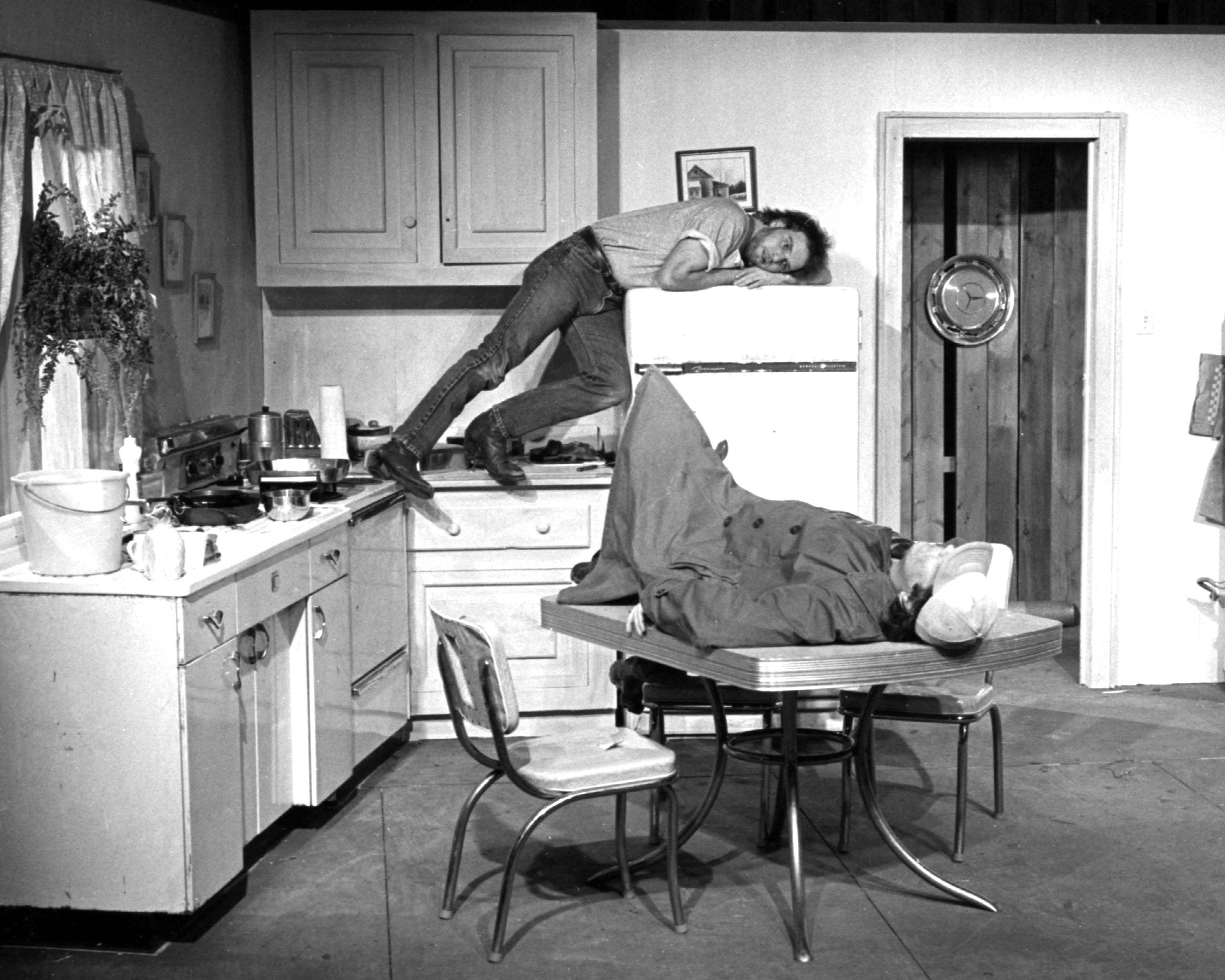
Not to worry; from the third week of rehearsal through closing night, Kevin’s character grew every night. I was impressed and bit scared for my own well-being. By opening night I discovered in one scene Kevin had ascended the heights of our kitchen and assumed a manic 45 degree angle against the fridge. I was supine on the kitchen table at the time and chaos was eminent.

It was a fine moment.

curse05
It was a fine moment

It was Kevin’s character that had to deal with the nude scene.

As the rehearsals proceeded, it was sometime in week three that it dawned on me that Joe was dealing with the nude scene by simply doing it as written.

Whatta concept!

What made the scene more special was that Kevin had to carry a sheep during it. This was after a first act scene in which he took his sister’s 4-H project “How to Butcher a Cow” chart, tossed it on the floor, and pee’d on it. He was an endearing character.

I was envisioning letters to the editor at least, or pitchforks and torches at worst. Didn’t happen. Instead, we played to great reviews and sold-out houses. Go figger.

About six months after the show closed, two gentlemen came to see me at work to discuss Liquor Barn’s participation in the United Way. One of the gentlemen noticed a picture on my office wall of one of my shows. He remarked; “My wife and I go to the theatre often. Last year we saw a play where a character actually pissed on the stage!” I gave him my biggest grin, shook his hand, and said; “I played that boy’s father!!”

That was the last I heard from the United Way that year.

But all in all, Curse of the Starving Class was a good experience.

  • Big audiences.
  • The building didn’t collapse.
  • I got to work with Cambo the Clown and his “Ya-Ya Juice” (another story for another time).
  • I didn’t have to deal with the sheep.

Baa-a-a-a.