If you hang out with theatre people for any length of time (say 15-20 minutes), you will hear many stories and quickly perceive that many of their stories fall into genres. Most theatre folks have tales about;
- Working with children.
- Working with animals.
- Costume or prop malfunctions.
- Outdoor theatre misadventures (there’s a sub-genre about bugs).
- And……fog.
Yes, fog.
And yes, I’ve got a few fog tales if you’ve got a minute (or say 15-20 minutes).
My fog adventures, unfortunately, are not John Carpenter’s; pirates emerging to terrorize my home town while Adrienne Barbeau croons seductively on the local radio station from her lighthouse studio.
Sigh.
I attribute that lack to the fact that Lexington is land-locked. Our nearest body of water is the Town Branch of Elkhorn Creek (and we covered that trickle with concrete a long time ago), our closest Pirates are the baseball team in Pittsburgh, and our closest lighthouse might be 400 miles away on Sullivan’s Island in Charleston.
No, my on-stage fog experiences are more pedestrian, but here they are anyway.
Fog in the theatre usually comes from machines though there are exceptions.
I was in a production of The World of Carl Sandberg in the spring of 1972. My friend and fellow cast member, Vicki James, gave a rendition of Mr. Sandburg’s poem “Fog” that was so evocative I remember it vividly 50+ years later. Indeed, I have many times been balked or paused in life, gathered myself……”and moved on.” Fog won’t stop me. It will only make me pause…think……and move on.
Ten years later, in a more-than-dubious production of Dracula, my friend and fellow cast member, Paul Thomas, managed to manufacture a personal fog bank by furiously puffing (heaving!) on his pipe in a sad attempt to obscure his presence in one particular way-more-than-dubious scene. I still harbor hope that I can forgive him for his attempted escape one day.
But those are exceptions. Most stage fog emanates from machines wittily referred to as “fog machines.”
My first experience with fog machines was in a 1981 production of Brigadoon. Oddly enough, it also included Paul Thomas, though in this case he is blameless. The show was in the Opera House in Lexington. The opening scene featured Paul and me as American hunters in the wilds of Scotland who have lost our way in the fog. We discuss our predicament and spot a village in the distance (neat trick considering the fog in which we’re supposed to be lost) – all behind a scrim as the orchestra in the pit plays gorgeous Lerner and Loewe music.
The dress rehearsal went fine, but the director wasn’t satisfied with the quality and quantity of the fog in the first scene. It wasn’t convincing as a fog that would baffle vibrant Americans. He ordered a second fog machine for opening night.
On opening night, the music began and the fog machines (plural) began. By the moment our opening lines were required, the fog, restrained by the scrim, had achieved a height of 7.3 feet. Paul and I could not see the audience, and the audience could not see us. When we spoke we waved our guns in the clear air above the fog to let the audience (and each other) know where we were.
Then the scrim arose and a slow tsunami of fog rolled out over the edge of the stage, into the orchestra pit, and into the first few rows of the audience. It was a blurry sight to see; the violinists slashing at the fog with their bows. I think they feared pirates were eminent. I think the audience in the front row feared they had been lured into a bizarre Gallagher-esque experience (albeit with prettier music).
We all tend to resist taking steps backwards in our lives, especially in the arts, but the second night’s performance of Brigadoon employed but one fog machine.
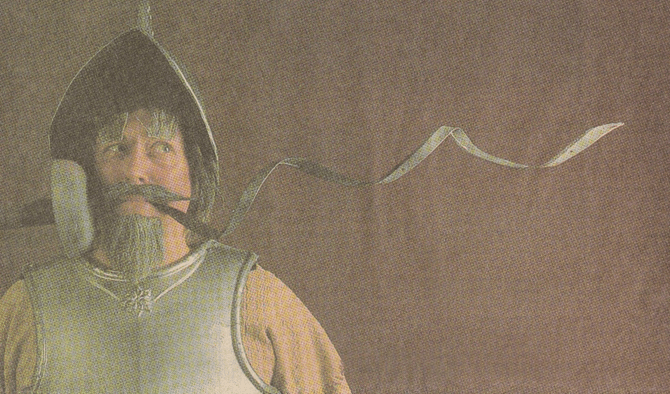
In 1989 I was cast in an outdoor production of King Lear as Lear’s Fool. I have played a couple of Shakespeare’s fools. I have a wealth of personal, real-life experience to bring to such roles. It’s a gift.
Early in the rehearsal process, I made a creative decision that was accepted as valid by the director, Joe Ferrell. I felt the Fool would grovel and slither throughout the story as he insinuated his opinions on Lear’s actions and decisions, never reaching past the height of Lear’s waist. I wore out a set of kneepads during the show’s run.
Mr. Ferrell had also made quite a few creative decisions himself (as directors are wont to do), one of which was to employ fog machines during Lear’s nighttime meanderings through the stormy countryside, bereft of shelter and family, and increasingly bereft of his very senses.
Reasonable enough.
From my Fool-ish point of view however (about three feet high, remember), the fog machine was at eye level and only an arm’s length away. In one long scene, as Lear (my friend and fellow cast member, Fred Foster) raged against his daughters, his fate, and the weather for what seemed like four iambically-pounding hours, I crouched in the mouth of the belching fog. My makeup melted off. My costume dripped in streams. I gurgled my lines.
When I came out for my curtain call, I didn’t bow.
Instead I shook myself like a dog to share my wealth of moisture with those nearby.
It’s good to share.
My favorite and grandest stage fog episode was on closing night of a 1992 production of Sweeney Todd.
The house was sold-out. The cast was in place behind the curtain prepared for their grand reveal. I was storming around backstage, working myself into a damn decent homicidal frenzy.
The fog machines commenced.
However, a sold-out house was not enough for the kind-hearted and slightly greedy director, Dr. James Rodgers. He was scurrying about to find room to seat some last-minute, ticketless arrivals. He had folding chairs located and brought to place one-by-one in the corners of the house.
The fog machines dutifully blew.
A pre-show announcement was deemed necessary.
The fog machines gleefully blew and blew.
The orchestra finally began the overture.
The curtain was raised.
The cast began to “…tell the tale of Sweeney Todd.”
I strode to the doors I expected to open and allow me to attempt to scare the bejeezus out 400+ people.
Instead, the fire alarm, triggered by the fog, had summoned first responders.
The fire department arrived with the Lexington and UK police – all with bells and whistles and lights a-blazin’. We were evacuated from the building; the audience to the front lawn of the Fine Arts building and the cast and crew to the street behind the building’s loading dock. Both groups could see other in the emergency-light-decorated twilight of a lovely Kentucky summer evening – a far cry from the dingy, industrial Fleet Street of our show.
Eventually, the authorities were persuaded that conflagration was unlikely. They were thanked for their efforts and invited to stay for the show. They chose to go about their duties instead, which was a good thing as I don’t know where Jim would’ve seated them! The audience, the orchestra, the crew, and the cast reassembled and an evening of theatre juiced by the pre-show capers turned out to be real nice clambake after all.
The fog machines were smug despite having grossly overplayed their part.


 June's Boy