Tag Archives: Studio Players

An Opera House…in Kentucky?

You Can't Take It 10It would have been about 1:00 in the afternoon on a weekday in 1970…
…in an opera house…
…in Lexington, Kentucky.

Why was I there?

Was it to see a production of Carmen, or Madama Butterfly, or Rigoletto?

Nah!

I was there for the weekday bargain matinée at the Opera House Movie House on a fairly sketchy block of North Broadway. For a $1.50 I was settling in for a cinema mini-festival of the Barbra Streisand/Jack Nicholson classic; On a Clear Day You Can See Forever (she sang, he didn’t…thank God) followed by Waterloo featuring Rod Steiger and Christopher Plummer in the mud (neither sang as I recall…thank God).

The theme of this film pairing is strikingly apparent; tedious films employing and contrasting singing and cannon fire as mediums for selling a ticket or two…and maybe a tub of Buttercup Popcorn.

Frankly, I don’t recall much of the afternoon that was indelible in an uplifting way. I recall a long afternoon of affordable and forgettable flicks. I recall dimness, not just in the screening room, but in the lobby (skimping on lighting – a double savings; lower electric bills and less spent on actual housekeeping). I recall passing on the Buttercup offerings; the dim lighting couldn’t obscure the sharp, refinery whiff emanating from the butter(?)-dispensing mechanism. I recall the occasional skittering noises of the legendary rodent cleaning crew in the dark rows of the screening room celebrating the discarded remains of the Buttercup offerings.

Hey!
Buck fifty.
Two films.
You get what you pay for.
Plus Yves Montand and Ivo Garrano…and Mickey and Jerry (without Tom).

Well…that was then.
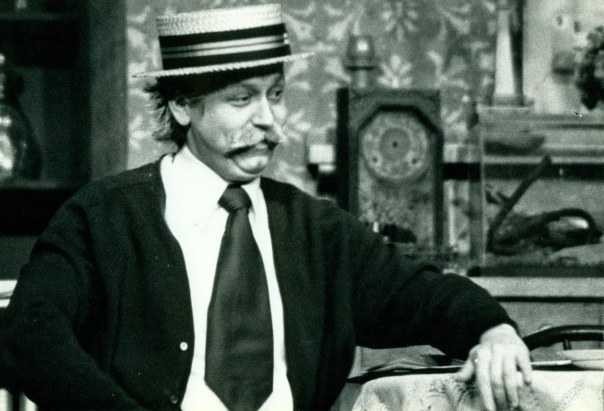
Eight years later, at age 27, I’m playing the 70+ year old Grandpa in Studio Players’ production of You Can’t Take It With You on the Opera House stage – same building. The seats are new. The balconies and boxes are gilded and populated with Lexington theater-goers. The lights are bright. The lobby, halls, staircases, carpets, and aisles are proudly pristine. No Buttercup products are in sight (or in smell).

What happened?

In the 70’s, the Opera House was attacked by ice storms, gravity, and old age. The wrecking ball loomed.
The city of Lexington and a group called The Opera House Fund said “No.”
A serious architect, and a serious Lexington, and a serious Opera House Fund (thank you Linda Carey and W. T. Young) redesigned and restored the structure – not to a museum roadside attraction, but to a thriving driver of Central Kentucky’s performing arts community.

A year after the success of You Can’t Take It With You, I played a deliciously young and foolish Cornelius in Studio Player’s production of Thornton Wilder’s The Matchmaker in a Saturday afternoon performance to 54 (count ‘em!) attendees in a house that seats about a thousand. Another fairly grim afternoon in the Opera House, but at least the grimness was in striving for something good, not for hygiene or affordability.

I should mention here that in both of these shows I got to work with my friend Paul Thomas. Paul has retired a myriad of times from the teaching profession and became the House Manager of the Opera House. I believe the Opera House muckety-mucks valued his participation, but were unaware that his best and highest use is ON-stage, not off. Such is fickle fame.

In 1981, I urged everyone to “Sit Down, You’re Rockin’ the Boat” in Lexington Musical Theatre’s production of Guys and Dolls. This was a notable production for Paul’s vocal exploration of musical scales of which Schoenberg never dreamed.

In 1982, Paul and I played in Brigadoon, also for Lexington Musical Theatre. Paul demonstrated a technique for holding a gun that the NRA is still trying to explain and justify.

Both of these edifying experiences were on the Opera House stage.

In 1987, I had the totaling fulfilling experience of playing Dr. Watson to my friend Eric Johnson’s Sherlock Holmes in the world premiere of my friend Chuck Pogue’s luscious script; The Ebony Ape, on the Opera House stage in an Actor’s Guild production. A two-story set, perfect and beautiful costumes, Fred Foster, Julieanne Pogue, Martha Campbell, Rick Scircle, Matt Regan…a glorious time for Mrs. Leasor’s little boy.

This was also on the Opera House stage…thank you very much.

A year later, in The King and I (a Lexington Musical Theatre production directed by my friend, Ralph Pate), Janie and I appeared in our one and only show together. She was lithe and lovely. I was…not so much, but I got to sing some beautiful songs for which I was not particularly suited (not, alas and thank God, an uncommon occurrence).

This was also on the Opera House stage. Sorry about the singing…but look at Janie! Isn’t she fine?
Carousel 01Now…
…skip ahead with me to 2006.

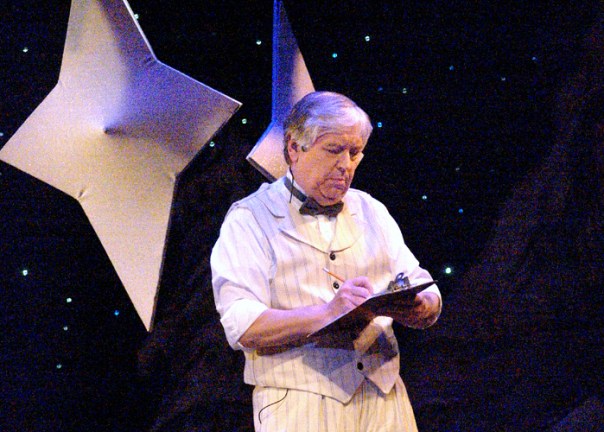
I’m asked to play the Star Keeper in the University of Kentucky Opera Theater’s production of Carousel at (you guessed it) the Opera House.

Well, I guess I could find time for that.

I got to walk out on the Opera House stage, count the stars – the stars!– , revive the protagonist and inspire him to briefly return to his former life and assure his daughter that she’ll “Never Walk Alone.”

Whoa.

This is a far cry from 1970 and Waterloo and…

“On a clear day, rise and look around you and you’ll see who you are.
On a clear day, how it will astound you that the glow of your being outshines every star.
You’ll be part of every mountain, sea, and shore.
You can hear from far and near the words you’ve never heard before.”


Well…
…maybe…
…not so very far.

A Runner Stumbles to 1977

I had a time-warp moment one night in 2018.

After our matinée performance of Lucas Hnath’s The Christians at AthensWest Theatre, there was a talk-back session with members of the audience. Talk-back sessions are not a thrill for me. They’re usually sparsely attended and fairly short, with a few timid questions and typically one unpredictable pompous answer that serves to evaporate any remaining questions, comments, or conversation.

But this show is atypical.

The innate civility of the script seemed to invite participation. Several dozen audience members lingered each night. People were moved and wanted to share…emphasis on “share”. They had been challenged to listen and think and explore without judgement or solution. They had not been challenged to either change or be considered deficient. There were no instant triggers to defend feelings or questions or beliefs. Curiosity and civility seemed to be in ascendance. Pomposity had left to beat the traffic.

After Sunday’s talk-back concluded, a lady approached me and said; “You probably don’t remember me…”

She was wrong.

Seeing her took me back 31 years.

I played a pastor in The Christians. The last time I played a religious leader was in 1977 at Studio Players. I played an erring priest in The Runner Stumbles. My Sunday questioner was my director for that show. How cool is that?

Runner Stumbles 06
The Runner Stumbles (1977)

However, rolling my mind back to 1977 and that show reminded me that I first met two great friends and actors in that production; Gene Arkle and Paul Thomas.

At the first company meeting of The Runner Stumbles, we were polled by our director to give our first impressions of the script. The gentleman to my right replied that the script reminded him of Mahler’s 2nd Symphony. He went on to elaborate, but he had lost me at Mahler. To me at that time, “Mahler” was just a clever rhyme in the song “Here’s to the Ladies Who Lunch” from Sondheim’s Company. I recall my impatience at the irrelevance of his remarks and being more than a little intimidated. The gentleman was Gene Arkle. My impatience was quickly unveiled as the young know-it-all’s folly it was. Gene and I went on to do a bunch of plays together (some of them were pretty good), and because of Gene, I delved into the symphonies of Mr. Mahler (ALL of them were pretty good – go figure).

During the first blocking rehearsal of Runner, I was sitting in a scene awaiting my church superior, played by an actor I had never met; Paul Thomas. He entered and intoned; “Father Rivard, it has come to our attention…” That’s as far as he got. My guffaw brought him to a halt.

I said he “intoned.”

Actually it sounded more like a cross between Gabby Hayes and a soupçon of Ethel Merman, with maybe a smidgen of dentist’s drill thrown in.

I truly thought it was a rehearsal gag. I was ashamed when I was discovered my error and have spent the ensuing 30+ years trying to make it up to my gifted friend. Paul and I have performed together about two dozen times and I was his best man when he and Lisa wed.

All of this flooded my mind when my Sunday lady prompted; “You probably don’t remember me…”

How wrong can a person be?

Moments of origin can’t be forgotten…certainly not by actors. We remember the people, the time, the place, the temperature, the wind direction, the smell, the sound. We dredge those moments from the past and use them to create today and hope always to launch new moments of origin…that won’t be forgotten.

It’s a powerful reason to get up in the morning…

Marilyn Moosnick…Firecracker!

One of the blessings of having been around the arts of a small city for a long, long time is the surplus of memories that every moment evokes.

One of the curses of having been around the arts of a small city for a long, long time is the surplus of memories…

One night before the start of AthensWest’s production The Christians, during a period of “quality green room time” (thank you, Paul Thomas for that concept) in the men’s dressing room, a few old Lexington theatre stories were spinning. Marilyn Moosnick was mentioned.

I’ve written before of Marilyn and the affectionate place she fills in my mind and heart (see “I Killed Peter Pan” in this blog).

Summertree 11
One o’ them Moosnicks (Greg) on the right

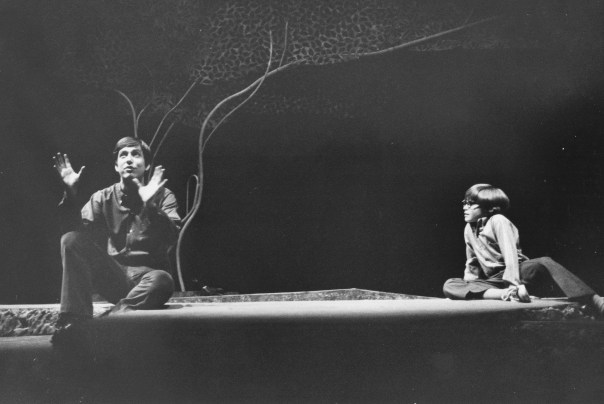
In college at UK, I acted with her sons in two plays; Summertree and The Night Thoreau Spent in Jail. She and her husband Franklin would pick the boys up after rehearsals and we would occasionally chat a bit. I perceived the pride she felt in her boys and the high standards to which they were held. They were standards for creativity…way more than standards for behavior. She expected her boys to respond with imagination, respect their elders, and respond with imagination…in that order. Oh…and learn their lines.

Marilyn had the gift of total attention.

When she turned to listen to you, the world was depopulated except for you. What you had to say might possibly change the world…or her opinion on the matter at hand, which was pretty much the same thing to me. It was daunting. It made you think…and think again before you blurted. Talking to Marilyn was playing with live ammunition.

That said, Marilyn was fey.

The stories of impetuousness are telling.

Her son Greg tells of a night at Studio Players. Marilyn and Franklin had been dating, but there as yet were no commitments. Marilyn was in the show and Franklin attended…with a date. As Franklin and his escort were exiting the performance, an errant jar of cold cream sailed from the second floor window of the theatre and shattered on the walkway, rendering the walkway hazardous and Franklin’s interest in his friend even more so.

Decades later, Marilyn and I served on a committee to raise funds to refurbish the Guignol Theatre. Marilyn volunteered to solicit Harry Dean Stanton – they had dated (once) when both were Theatre Department undergraduates in the fifties. She later related to the committee her phone conversation with Stanton. Harry reportedly said; “Marilyn, honey, you sound like a real firecracker, and I’m sure we had a real good time…but I’m broke.”

She encouraged me. She scolded me. She encouraged me. She listened to me. She encouraged me.

She did the same for Lexington…in that order.

She was a firecracker.

I miss her.

Hey! It’s What We Do

fifth-07

I’ve written before about the first time I was directed by Joe Ferrell in That Championship Season on the Laboratory Theatre stage at the University of Kentucky. A couple of years after that show, Joe cast me as Kenny Talley in The Fifth of July on the Guignol Stage at UK. It was a wondrous cast, though at the time they were all new to me as performers except for the actor playing Jed. I had just finished directing him in Whodunit Darling at Studio Players, but I had never worked with Martha, Sheila, Tim, Michael, or Sue. The early rehearsals were filled with delightfully intimidating discoveries as we explored each other’s’ storytelling gifts. I’ve gone on happily to do a lot of theatre with those folks. I count every one of them as an admired friend.

“Jed” and I had the interesting challenge (for the mid-1980’s) of two straight actors playing gay lovers. My character had the further complication of being a double AK amputee veteran of the Vietnam War.

Hey!

I know it’s a stretch.

That’s why we’re here.

It’s what we do.

In the first scene of the play, in the first ten minutes of the play, Jed and Kenny (my character) quarrel about our garden, our house, our guests, and our lives. The argument reaches its peak and a relationship-testing silence ensues. In that silence, Jed kisses Kenny and we all understand in that moment there are things on the planet more important than our garden, our house, and our guests…and maybe our lives. It is our loves that matter. Having established that “minor” understanding, we can now have a play and tell our story.

An explanation is in order here.

I love to rehearse.

Strangely enough, I also like to audition. Un-strangely enough, I really like to perform.

But I love to rehearse.

By the time an audience sees the show, they’re only seeing one of about a dozen things we’ve tried in rehearsal. Many of those unseen choices are embarrassing or just plain awful, but in rehearsal it’s OK to try ‘em anyway. It’s where a useful new reality gets invented; the “alternative” reality of an imaginary world. For me, there may not be a more powerful reality. But…it’s not for the real world. Don’t try this at home. And most certainly don’t try this in the White House. Please.

This was our first rehearsal on our feet for The Fifth of July.

The first few rehearsals of a Joe Ferrell-directed play usually take place around a table, reading and discussing. That’s good, that’s good…but let’s get up and move, even if it’s with crutches (double AK amputee, remember?).

For this first rehearsal on our feet, we were in a large rehearsal room and we began at the top of the show. “Jed” and I were on stage and the rest of the cast arranged themselves around the perimeter of the room with their books and knitting and whittling. I’m lyin’ ‘bout the whittling, but remember these were primitive days before laptops, ipads, and smart phones. Hell, this was back when you actually had to know things – you couldn’t just google it – primitive! I like it better now.

Jed and I stumbled through the opening argument and arrived at the kiss.

The rehearsal room became silent. Everyone was still bent over their distractions, but their eyes had shifted to an impossible position on the side of their heads. Avid nonchalance reigned.

Silent…

Like the first time you mentioned a girl to your parents…

Silent…

Like your wisest response to the officer’s query; “Sir, do you know why I pulled you over?”…

Silent…

Like your friends’ reactions when you let slip the fact you actually liked Independence Day: Resurrection.

Silent.

We went on for a few more lines and then Joe stopped us. I vaguely remember we discussed the opening spat and the possible reasons for it. We discussed phlox and verbena in Jed’s garden and what legless Kenny might see every morning in the mirror. Then we did the scene again from the top.

The big moment returned and so did the silence.

We stopped again and discussed how we felt about Aunt Sally’s (Martha’s character) visit, and my feckless friends’ (Sue and Michael) visit, and the heat of a Fourth of July weekend in Missouri. And we did the scene again.

And again.

And again.

By about the tenth time through, the kiss meant nothing except in the flow of the story of these two men. It also meant nothing to the rest of the cast except for their desire for us to get it right so they could finally rehearse their scenes.

Awkwardness had been diffused – an urgent truth had coalesced in its place.

A new reality had been established in about 45 minutes.

Hey!

It’s what we do.

25 years later or so, I was cast by Joe in his production of A Lion in Winter at Woodford Theatre. My character had to kiss his mistress (30+ years younger than me) in front of his wife and his grown children in full knowledge of all involved. Awkward.

We did the scene once, stopped, discussed, Joe suggested a cruel, slow, twirl of the young lady in the face of the family to precede the kiss. We did the scene once more. A new reality was created in about 15 minutes.

Hey!

It’s what we do.

We seek surprise to capture it and add it to what we are.

We open ourselves to growth and growth comes.

We grow bigger as our world grows bigger.

It’s what we do.